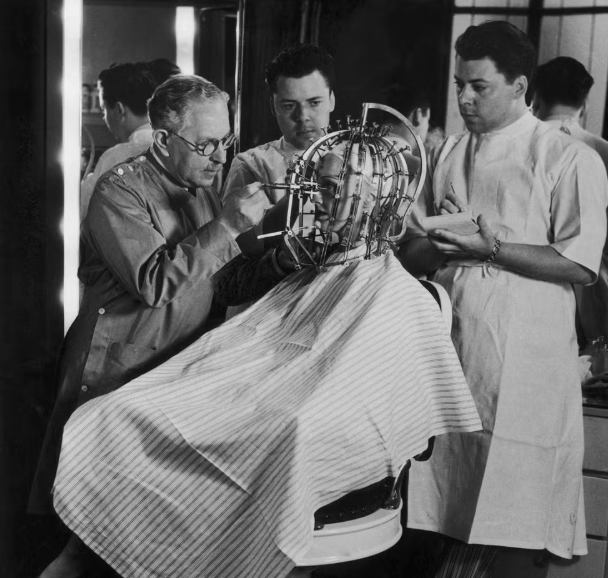
When the early 1930s rolled around, beauty culture flirted with science — or at least with the appearance of science. One of the most striking examples was the Beauty Calibrator, a metal measuring device used by beauticians to map and “diagnose” a client’s facial proportions. This contraption was used to measure the client’s head and help determine which areas were best to disguise and which features could be enhanced through makeup.
It was beauty analysis before contour charts, face‑shape theory, or personalized makeup consultations existed — a moment when glamour was treated like geometry.
The calibrator was placed around the head like a skeletal halo. Adjustable metal arms allowed the beautician to assess symmetry, identify “imbalances,” and map facial planes to decide where shading or highlighting should be applied. It was a mechanical version of what makeup artists now do instinctively: study bone structure to sculpt, soften or emphasize features.
The 1930s were obsessed with scientific beauty, driven by salons that marketed treatments as precision‑based and corrective. Women were told their faces could be optimized through measurement and technique. The Beauty Calibrator fit perfectly into this mindset: beauty as a problem to be solved.
Today’s contouring, highlighting and face‑mapping all trace back to this era — making the calibrator a fascinating artifact in the evolution of beauty culture.
I’m Stacey Hobbs, thanks for reading Face by Stace! Until next time.
do you feel fabulous today?

