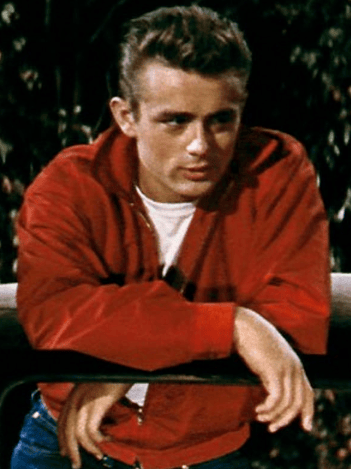
James Dean didn’t simply enter Hollywood, he arrived like a spark in dry grass, igniting a cultural fire that never went out. If Marlon Brando created the language of rebellion, Dean turned it into poetry. His beauty wasn’t polished or manufactured. It was fragile, restless and emotionally exposed. He embodied a new kind of masculine allure: the beauty of vulnerability.

Dean’s aesthetic was deceptively simple. The white T‑shirt, the red jacket, the denim — all ordinary pieces, yet electrified by the way he wore them. He didn’t perform coolness; he radiated it. His slouched posture, the half‑smile, the searching eyes, the way he held tension in his shoulders — everything about him suggested a young man caught between longing and defiance. He made emotional conflict look cinematic.
What set Dean apart was the way he allowed audiences to see him break. In Rebel Without a Cause, he didn’t hide his pain behind bravado. He let it spill out, raw and un-filtered. His beauty came from the cracks, not the surface. He showed that masculinity could be tender, confused, aching — and still magnetic. This was revolutionary in a decade that prized stoicism.
Dean’s performances carried a kind of emotional transparency that felt almost dangerous. He didn’t act from the outside in; he acted from the inside out. Every gesture felt like a confession. Every silence felt like a wound. He made vulnerability iconic and in doing so, re-shaped the cultural understanding of male beauty.
And then, the tragedy.
Dean’s death at twenty‑four froze him in time. He became a myth — a symbol of youth, rebellion and the fleeting nature of beauty. His legacy isn’t just cinematic; it’s emotional. He represents the beauty of what is un-finished, the allure of what is unresolved. He is the eternal rebel, forever young, forever searching.
If Brando was the foundation and The Godfather was the evolution, Dean was the emotional climax — the moment when rebellion became art.
Brando taught men how to look powerful.
Dean taught them how to look human.
Together, they shaped the modern masculine aesthetic.
Dean remains its most haunting chapter.
I’m Stacey Hobbs, thanks for reading Face by Stace! Until next time.
do you feel fabulous today?
P. S. I do really enjoy this movie of his, “A Rebel Without A Cause.”

