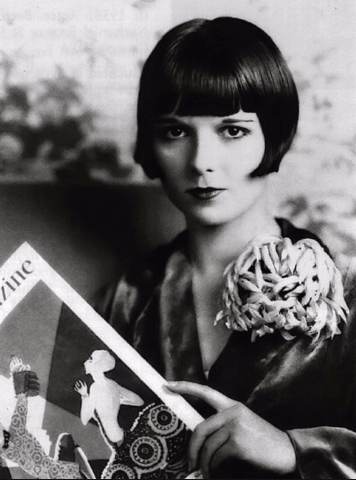
Louise Brooks didn’t just wear the flapper look — she defined it. Her razor‑sharp black bob, her minimalist wardrobe and her cool, modern presence created the visual blueprint of the 1920s. When people imagine the flapper, they’re often imagining Louise Brooks.

Her haircut was a cultural shock. The bob had existed before but Brooks made it iconic: blunt, geometric and un-apologetically modern. It framed the face like architecture, turning the flapper into a symbol of independence. Women across America, Canada and Europe walked into salons asking for “the Louise Brooks cut,” transforming beauty culture overnight.
Her silhouette was equally influential. Brooks favoured slim, straight dresses that moved with the body — the perfect match for the Jazz Age’s energy. She danced, acted and lived with a freedom that matched her clothes. Her style rejected the heavy Edwardian past and embraced a future where women could move, work and express themselves without restriction.
On screen, Brooks amplified the flapper’s attitude: witty, self‑possessed and emotionally complex. She wasn’t just fashionable — she embodied the spirit of the era. Her films captured the modern woman in motion, making her a global symbol of the 1920s aesthetic.
Louise Brooks gave the flapper her face, her hair, and her silhouette. She turned a cultural shift into a visual revolution.
I’m Stacey Hobbs, thanks for reading Face by Stace! Until next time.
do you feel fabulous today?
 Face by Stace