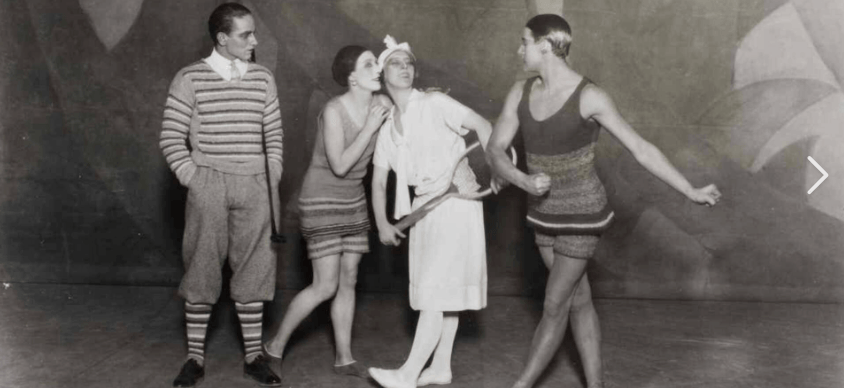
Where couture met choreography — and modernism found its stage.
Before Chanel became synonymous with the little black dress and the discipline of line, she was transforming another world: the avant‑garde stage. Her collaboration with Sergei Diaghilev and the Ballets Russes was one of the most important — and least discussed — chapters of her career.
Diaghilev didn’t choose collaborators lightly. He chose visionaries.
And Chanel was exactly that.
A Modernist Among Modernists
The Ballets Russes was the epicentre of artistic revolution — Picasso, Matisse, Stravinsky, Cocteau, Nijinsky. Chanel entered this circle not as a spectator but as a creator.
Her costumes for Le Train Bleu (1924) were radical for their time:
- athletic silhouettes
- jersey fabrics
- clean, geometric lines
- a rejection of theatrical excess
Chanel didn’t dress dancers as fantasy creatures.
She dressed them as modern women.
It was a shock to Paris — and a revelation.
The Chanel–Diaghilev Dynamic
Diaghilev admired Chanel’s discipline. Chanel admired Diaghilev’s audacity.
Their collaboration was built on mutual respect, as opposed to ego. Chanel even helped fund Diaghilev during challenging times, providing absolute support towards the company that had become her artistic home.
The Ballets Russes shaped Chanel’s aesthetic:
- her love of movement
- her architectural simplicity
- her fascination with modern geometry
- her belief that beauty must serve life
Chanel did much more than design costumes, she designed the stage.
I’m Stacey Hobbs, thanks for reading Face by Stace! Until next time.
do you feel fabulous today?
 Face by Stace