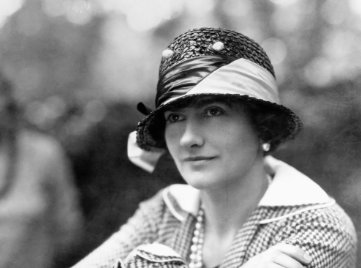
When the queen of Paris couture stepped into the dream factory.
Hollywood in the 1930s was a world of sequins, satin, and spectacle — a place where glamour was engineered, lit, and projected onto screens larger than life. And into this world walked Gabrielle Chanel, the woman who had spent her career stripping fashion down to its essential lines.
It was an unlikely pairing. But it was inevitable.
The Invitation: Hollywood Wants Chanel
In 1931, Samuel Goldwyn — one of the founding giants of Hollywood — travelled to Paris with a proposition. He wanted Chanel to design costumes for his stars, believing her modern French chic would elevate American cinema.
Goldwyn offered her a staggering sum: one million dollars, paid in installments.
For Chanel, who had already conquered Paris, Deauville, and the avant‑garde stage, Hollywood was the next frontier.
She accepted.
Chanel Arrives in Los Angeles
When Chanel arrived in Hollywood, she was greeted like royalty. The studios expected sparkle, fantasy and theatrical glamour.
But Chanel brought restraint, geometry, clean lines and modern silhouettes.
She dressed actresses not as real women — elegant, intelligent and contemporary.
It was revolutionary.
It was also controversial.
The Clash: Chanel vs. Hollywood Excess
Hollywood wanted costumes that dazzled under the lights.
Chanel wanted clothes that moved with the woman.
Her designs were:
- too subtle for Technicolour
- too modern for melodrama
- too architectural for fantasy plots
Actresses adored her.
Studio heads did not.
Chanel famously said:
“Hollywood is the capital of bad taste.”
It was a sharp line — but it revealed the core tension.
Chanel believed in truth.
Hollywood believed in illusion.
Why Chanel Ultimately Left Hollywood
Chanel’s time in Hollywood was brief — less than a year. She returned to Paris with clarity:
Hollywood was not her stage. Her work belonged to real life, not fantasy.
But her impact lingered.
She introduced:
- the modern suit
- the clean evening gown
- the minimalist silhouette
- the idea that elegance could be quiet
Hollywood didn’t adopt her aesthetic immediately. But decades later, her influence became the foundation of modern red‑carpet dressing.
The Legacy: Chanel’s Hollywood, Re-imagined
Today, Chanel’s relationship with Hollywood is iconic:
- actresses wear Chanel couture to the Oscars
- Chanel ambassadors dominate film festivals
- the brand’s aesthetic defines modern screen elegance
What Hollywood rejected in 1931 became the blueprint for cinematic chic.
Chanel didn’t bend to Hollywood.
Hollywood eventually bent to Chanel.
I’m Stacey Hobbs, thanks for reading Face by Stace! Until next time.
do you feel fabulous today?
 Face by Stace