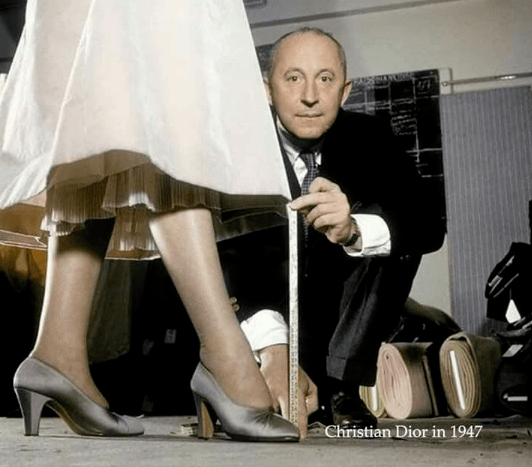
Chanel and Dior stand as two pillars of twentieth‑century fashion but their visions could not have been more different. They shaped the same era, dressed many of the same women and defined modern style — yet they approached the female body from opposite philosophies. To understand French fashion, you must understand this tension: Chanel liberated women; Dior re‑sculpted them. Chanel erased artifice; Dior exalted it. Chanel designed for life; Dior designed for fantasy.
Chanel: Liberation Through Ease
Chanel’s revolution was one of freedom. She stripped fashion of its constraints — corsets, padding, heavy fabrics, decorative excess — and replaced them with movement, comfort and clarity. Her clothes followed the body rather than forcing it into shape. She designed directly on the body, draping fabric with her hands, refining through touch rather than sketch.
Her silhouettes were long, lean and fluid. Jersey dresses, cardigan jackets, sailor knits, and the iconic Chanel suit all shared the same philosophy: a woman should be able to breathe, walk, work and live in her clothes. Chanel’s elegance came from restraint — a refusal to add anything that did not serve the woman wearing it. Her revolution was modernity itself: clothes that felt natural, intuitive and quietly confident.
Dior: Structure Through Fantasy
Dior’s revolution was one of return — a revival of femininity expressed through structure, volume, and theatrical silhouette. Where Chanel dissolved the waistline, Dior cinched it. Where Chanel flattened the bust, Dior sculpted it. Where Chanel simplified, Dior amplified.
His 1947 New Look was a deliberate counterpoint to Chanel’s ease: nipped waists, padded hips, full skirts, and engineered underpinnings that re-shaped the female body into an hourglass ideal. Dior’s clothes were fantasies made real — garments that required posture, discipline and a certain stillness. He believed fashion should transform a woman not simply accompany her. His couture was architectural but in a different way from Balenciaga: Dior built beauty through structure, not purity.
Two Philosophies, One Era
Chanel and Dior did not contradict each other; they defined the spectrum of modern femininity.
- Chanel offered liberation.
- Dior offered glamour.
- Chanel designed for movement.
- Dior designed for silhouette.
- Chanel erased artifice.
- Dior celebrated it.
Their co-existence created the dynamic tension that shaped mid‑century fashion. Chanel gave women autonomy; Dior gave them drama. Chanel’s clothes felt lived‑in; Dior’s felt ceremonial. Chanel’s revolution was social; Dior’s was aesthetic.
Today’s designers still choose a side — or attempt to reconcile both. Minimalism traces back to Chanel’s clarity. Maximalist couture traces back to Dior’s structure. Every debate about comfort versus glamour, ease versus form, reality versus fantasy, echoes the divide between these two giants.
Chanel changed how women lived. Dior changed how women looked.
Together, they built the modern fashion landscape.
I’m Stacey Hobbs, thanks for reading Face by Stace! Until next time.
do you feel fabulous today?
 Face by Stace