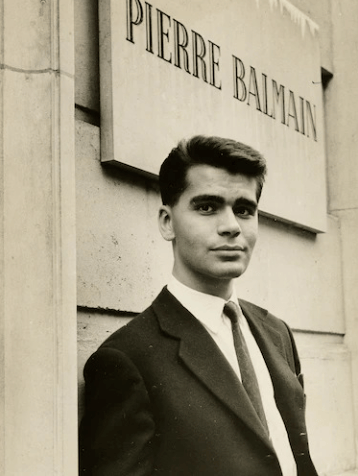
Before Chanel, before Fendi — Karl Lagerfeld learned couture under the house that defined Parisian discipline.
Long before Karl Lagerfeld became the architect of modern Chanel, he was a young designer absorbing the strict, sculptural discipline of Pierre Balmain — one of the great post‑war couturiers. Their relationship wasn’t just professional. It was formative. Balmain shaped Lagerfeld’s eye, his rigor and his understanding of silhouette.
This is the chapter of Lagerfeld’s life most people forget — the Balmain years.
Balmain: The House of Architectural Elegance
Pierre Balmain was known for:
- long, columnar lines
- sculpted waists
- impeccable tailoring
- a kind of aristocratic restraint
His couture was architectural — not decorative. He believed a dress should stand on its own and not like a building.
This philosophy became the foundation of Lagerfeld’s later work.
Karl Lagerfeld Arrives at Balmain (1955)
At just 21, Karl Lagerfeld won the International Wool Secretariat competition — the same competition Yves Saint Laurent won in the same year. Balmain hired him immediately.
This was Lagerfeld’s first real job in couture. Inside Balmain’s atelier, he learned:
- discipline
- construction
- the mathematics of silhouette
- the importance of proportion
- the power of a controlled line
Balmain was strict.
Lagerfeld was brilliant.
The combination was electric.
The Balmain–Lagerfeld Dynamic
Their relationship was complex — part mentorship, part rivalry, part creative tension.
Balmain saw Lagerfeld’s talent but also his ambition. Lagerfeld admired Balmain’s discipline but resisted his rigidity.
Balmain was the architect.
Lagerfeld was the provocateur.
This tension shaped Lagerfeld’s future aesthetic: classic structure with modern irreverence.
Why Balmain Mattered to Lagerfeld’s Evolution
You can see Balmain’s influence throughout Lagerfeld’s career:
At Chloé
The softness and femininity were new but the underlying structure — the way the garments held shape — came from Balmain.
At Fendi
The architectural approach to fur, the sculptural coats, the precision — pure Balmain discipline.
At Chanel
The clean jackets, the controlled silhouettes, the razor‑sharp tailoring — all rooted in Balmain’s couture training.
Balmain gave Lagerfeld the skeleton. Lagerfeld built the empire.
The Aesthetic Contrast: Balmain vs. Lagerfeld
Balmain believed in:
- elegance
- restraint
- aristocratic femininity
Lagerfeld believed in:
- modernity
- provocation
- constant reinvention
Balmain was the old world.
Lagerfeld was the new.
Their relationship is one of the great generational handoffs in fashion — the passing of couture discipline from one master to the next.
The Legacy: Balmain in Lagerfeld’s DNA
Even at Chanel, decades later, Lagerfeld often said:
“You must know the rules to break them.”
Those rules were Balmain’s.
Every sharp shoulder, every sculpted jacket, every architectural silhouette Lagerfeld sent down the runway carried the imprint of his first teacher.
Balmain didn’t make Lagerfeld. But he made Lagerfeld possible.
I’m Stacey Hobbs, thanks for reading Face by Stace! Until next time.
do you feel fabulous today?
 Face by Stace