The Woman Who Built a World
By the time Jeanne Lanvin reached the height of her career, she was no longer simply a couturière — she was an architect of elegance. Her work didn’t just dress women; it shaped how they moved, how they felt and how they understood femininity in a rapidly changing world.
Lanvin’s legacy is often described as “refined,” “feminine,” or “decorative,” but these words barely scratch the surface. What she built was a complete universe— one defined by craftsmanship, colour, intimacy and emotional intelligence.
This chapter explores the architecture of that universe.
1. The Atelier as a Sanctuary
Lanvin’s atelier was not a factory of fashion; it was a sanctuary of craft.
Inside her workrooms:
- embroidery was treated like fine art
- fabric was handled with reverence
- silhouettes were sculpted not sewn
- artisans were collaborators not labourers
Lanvin believed that beauty required devotion. Her atelier embodied that belief.
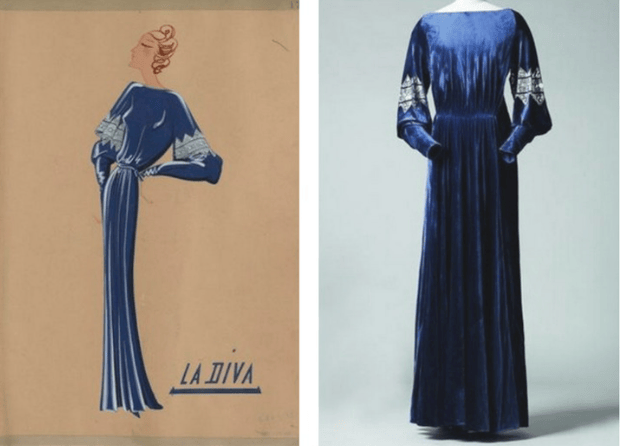
Where Chanel stripped fashion down to its essentials, Lanvin elevated it through detail — beadwork, appliqué, metallic threads, hand‑finished hems. Her garments were not merely worn; they were experienced.
This devotion to craft became the backbone of her legacy.
2. The Emotional Blueprint: Motherhood as Muse
Lanvin’s daughter, Marguerite, was not just her muse — she was the emotional blueprint of the entire house.
The mother‑daughter bond shaped:
- the softness of Lanvin silhouettes
- the romanticism of her colour palette
- the tenderness of her embroidery
- the intimacy of her couture philosophy
Lanvin understood women not as fashion subjects but as emotional beings. Her designs reflected:
- protection
- affection
- celebration
- continuity
This is why her clothes feel different. They carry emotional architecture — a sense of care stitched into every seam.
3. The Colour That Became a Signature: Lanvin Blue
Lanvin Blue is one of the most iconic colours in fashion history — a deep, celestial, almost spiritual shade inspired by Renaissance paintings.
It became:
- her signature
- her identity
- her visual language
Lanvin Blue communicated:
- serenity
- nobility
- timelessness
- femininity without fragility
In an era obsessed with black (Chanel) and surrealist shock (Schiaparelli), Lanvin Blue stood as a quiet rebellion — a reminder that elegance could be powerful without being loud.
4. The Robe de Style: A Couture Revolution
The robe de style is Lanvin’s most famous silhouette — a structured, pannier‑inspired gown that blended:
- 18th‑century shape
- 20th‑century modernity
- Lanvin’s signature femininity
It was revolutionary because it defied the era.
While the 1920s embraced:
- straight lines
- boyish silhouettes
- androgyny
Lanvin offered:
- curves
- volume
- romanticism
- historical reference
The robe de style became a symbol of her house — a silhouette that honoured tradition while feeling modern.
It is still studied in museums today.
5. The House That Expanded Beyond Couture
Lanvin was one of the first designers to understand that a fashion house could be more than clothing.
She expanded into:
- children’s wear
- menswear
- home décor
- fragrance (Arpège)
- interior design
- lifestyle branding
Arpège, launched in 1927, remains one of the most iconic perfumes in the world — a testament to her ability to translate emotion into scent.
Lanvin built a lifestyle brand before lifestyle branding existed.
6. The Quiet Power of Her Legacy
Lanvin’s legacy is not loud — it is enduring.
She left behind:
- a couture archive revered by historians
- a colour that became immortal
- a silhouette that defined an era
- a fragrance that still whispers her name
- a philosophy rooted in care, craft and emotional intelligence
Her influence lives in:
- Valentino’s romanticism
- Dior’s femininity
- modern couture embroidery
- museum exhibitions around the world
Lanvin proved that elegance is not a trend — it is a language.
7. Why Lanvin Still Matters
In a fashion world obsessed with spectacle, Lanvin’s work reminds us that:
- beauty can be quiet
- femininity can be powerful
- craft can be revolutionary
- emotion can be a design principle
Lanvin’s world was built on:
- devotion
- detail
- intimacy
- artistry
And that world still feels modern.
I’m Stacey Hobbs, thanks for reading Face by Stace! Until next time.
do you feel fabulous today?
 Face by Stace