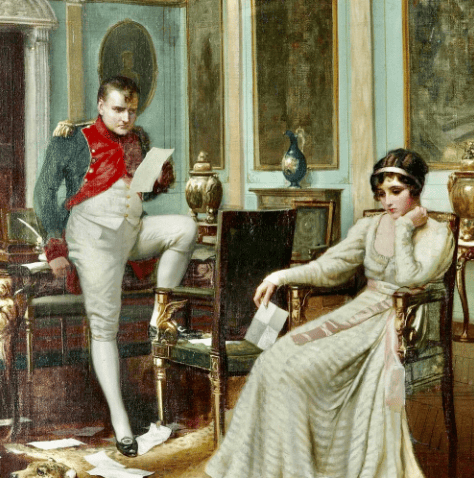
The years between 1810 and 1815 mark one of the most fascinating transitions in French beauty history. As Napoléon’s empire began to fracture, the aesthetics of France shifted — subtly at first, then dramatically. Beauty, fashion and grooming became mirrors of political instability, emotional un-certainty and cultural re‑evaluation.
The Waning Glow of Imperial Grandeur
During the height of Napoléon’s reign, beauty was synonymous with discipline, refinement and luxury. Grooming was a symbol of power — a way to project control in a world shaped by conquest. But as the empire weakened, beauty softened. The rigid elegance of the early empire gave way to a more introspective aesthetic.
Josephine’s Enduring Influence
Even as her marriage to Napoléon dissolved, Josephine remained a beauty icon. Her signature look — soft curls, empire silhouettes, delicate perfumes — continued to influence French women. But her style also began to symbolize nostalgia: a longing for stability in a time of political upheaval.
Perfume as Emotional Armor
Napoléon’s obsession with cologne intensified during the decline. He famously used enormous quantities of Eau de Cologne, believing scent could fortify the spirit. Perfume houses thrived, creating blends that balanced freshness with emotional depth. Fragrance became a coping mechanism — a way to maintain dignity amid uncertainty.
The Rise of Subtlety
As resources tightened and public sentiment shifted, beauty became more understated. Women embraced softer fabrics, muted palettes, simpler hairstyles and naturalistic make-up
This was not a rejection of elegance — it was a recalibration.
Beauty as Resilience
The decline of the empire forced France to reconsider its identity. Beauty became a quiet act of resilience. Grooming rituals persisted even as political structures crumbled. In this period, French beauty transformed from a symbol of power to a symbol of endurance.
The Legacy of Transition
The years 1810–1815 laid the groundwork for modern French beauty:
- subtle luxury
- emotional elegance
- refined simplicity
- beauty as cultural identity
This chapter marks the moment when French beauty became not just aesthetic — but philosophical.
I’m Stacey Hobbs, thanks for reading for Face by Stace! Until next time.
do you feel fabulous today?
 Face by Stace