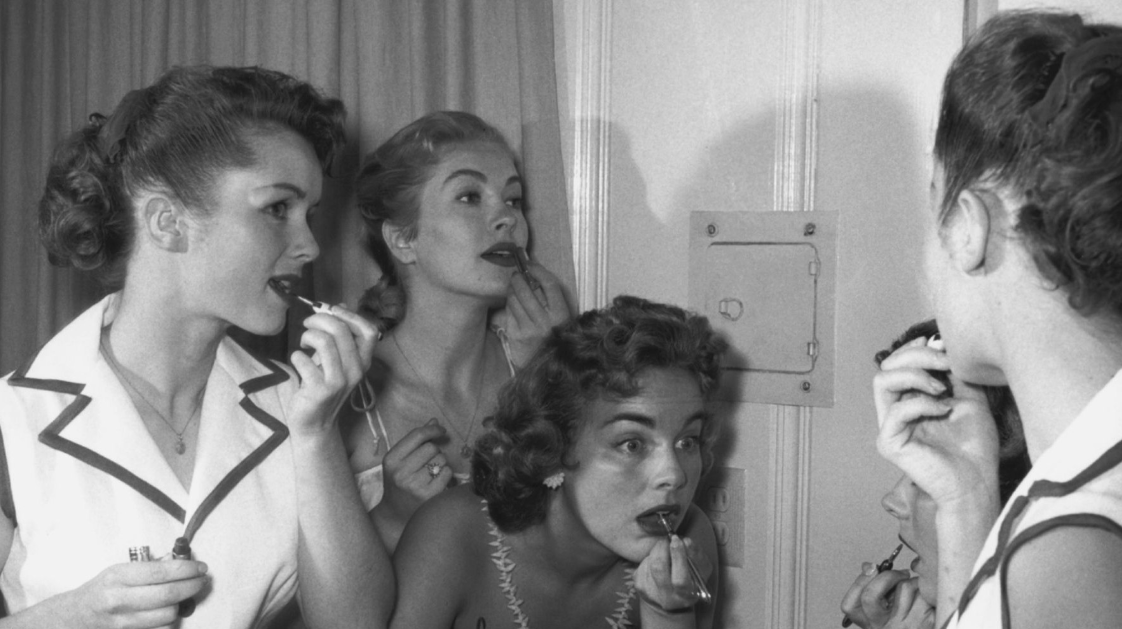
The 1950s were a turning point in cosmetic chemistry. After WW2 the beauty industry had access to new synthetic dyes, improved waxes and long‑wearing film‑forming ingredients that didn’t exist in earlier decades. Women wanted lip colour that survived eating, smoking, kissing and the long workday — and chemists finally had the tools to deliver it.
This led to the rise of “indelible” lipsticks: formulas marketed as smear‑proof, kiss‑proof and stay‑on‑all‑day.
The Chemistry Behind Indelible Lipstick
1. Coal‑Tar Lake Dyes (FD&C Lakes)
These were the heart of 1950s long‑wear formulas.
- They are insoluble pigments made by bonding dyes to aluminum or barium salts.
- Because they don’t dissolve easily, they stain the lips and resist smudging.
- They produced the era’s signature deep reds and blue‑reds.
This was a major shift from earlier vegetable dyes and carmine.
2. Petroleum‑Derived Waxes & Oils
Post-war petrochemical innovation introduced:
- Microcrystalline wax
- Petrolatum
- Mineral oil
These created a flexible, durable film on the lips, helping pigment adhere for hours.
Earlier lipsticks used beeswax and castor oil, which were softer and melted easily. Prior to beeswax and castor oil, whale fat was used, the ingredient on lipstick tubes read “crimson,” as marketers had conjured up this word because it sounded oh-so pretty as opposed to whale fat. Whale fat was used as wax.
3. Film‑Formers (Early Polymers)
This is where “indelible” truly became possible.
Chemists began adding synthetic polymers that formed a thin, dry film on the lips. Examples included:
- Polyvinyl derivatives
- Early acrylic resins
- Cellulose-based polymers
These ingredients made lipstick transfer‑resistant, though sometimes at the cost of comfort — many women complained of dryness.
4. Solvent‑Based Application
Some 1950s long‑wear lipsticks were applied with a solvent system that evaporated, leaving behind a stain and film.
This is the ancestor of today’s liquid matte lipsticks.
Cultural Context: Why Women Wanted Indelible Lipstick

Postwar Lifestyle
Women were working, commuting, smoking, eating on the go; they wanted makeup that kept up.
Hollywood Influence
Stars like Marilyn Monroe and Elizabeth Taylor popularized perfect, unbroken red lips, pushing demand for formulas that didn’t fade on camera.
Advertising Boom
Brands aggressively marketed “kiss‑proof,” “smear‑proof,” and “never‑comes‑off” lipsticks — tapping into romance, glamour, and modernity.
Key Brands in the 1950s Indelible Lipstick Boom
- Revlon – led the charge with long‑wear reds and “Frosted” finishes.
- Hazel Bishop – famous for “Lasting Lipstick,” one of the first truly smear‑proof formulas.
- Max Factor – Hollywood‑driven innovations including film‑ready pigments.
- Maybelline – expanded into lip products using new synthetic dyes.
Hazel Bishop’s smear‑proof lipstick was so successful it triggered one of the biggest advertising wars in cosmetic history.
I’m Stacey Hobbs, thanks for reading Face by Stace! Until next time.
do you feel fabulous today?
 Face by Stace