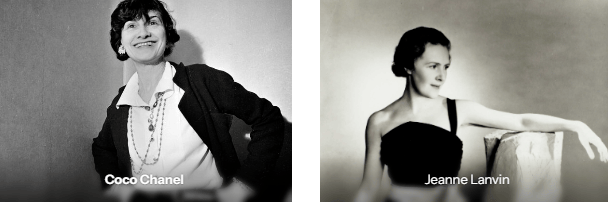
Paris in the 1920s was a city vibrating with reinvention. Jazz spilled from smoky clubs, Art Deco lines carved themselves into architecture, and couture houses rose like temples along the Rue du Faubourg Saint‑Honoré. It was a decade of speed, electricity, and ambition and at its centre stood two women shaping the future of fashion with opposing visions.
Coco Chanel and Jeanne Lanvin were no longer milliners. They were empresses.
Their feud, once a quiet tension, now pulsed through the salons of Paris. Critics compared them relentlessly. Clients whispered about them over tea at the Ritz. Journalists framed them as aesthetic opposites, two poles of femininity pulling the city in different directions.
And they were.
Chanel: The Modernist Rebel
Chanel’s world was sharp, architectural, and un-compromising. She stripped fashion down to its bones — jersey, tweed, black, white, clean lines, freedom of movement. Her clothes were liberation. She rejected ornament as frivolous, colour as sentimental, and tradition as suffocating.
Her woman walked fast.
Her woman worked.
Her woman refused to be decorative.
Chanel’s aesthetic was a revolution — and revolutions demand enemies.
Lanvin: The Romantic Couturière
Lanvin’s world was the opposite: soft, luminous, and emotionally intelligent. Her gowns floated, her embroidery shimmered, her colours glowed like frescoes. She believed beauty was nourishment, not rebellion. Her silhouettes honoured the body rather than defied it. Her embellishment was delicate, spiritual, and precise.
Her woman glided.
Her woman dreamed.
Her woman embraced elegance as a form of self‑expression.
Lanvin’s aesthetic was devotion — and devotion demands defenders.
Paris Chooses Sides
The city divided itself.
Women who wanted power chose Chanel.
Women who wanted poetry chose Lanvin.
Women who wanted both found themselves torn between two queens.
The rivalry intensified not through public insults, but through design. Each collection felt like a response to the other. Chanel would debut a stark black dress; Lanvin would unveil a gown in celestial blue. Chanel would cut away ornament; Lanvin would introduce embroidery that looked like starlight. Chanel would champion simplicity; Lanvin would elevate complexity.
It was a duel fought in silk and jersey, in colour and absence, in philosophy and silhouette.
The Press Fans the Flames
Fashion writers adored the drama. They framed Chanel as the future and Lanvin as the heart. They described Chanel’s woman as modern and Lanvin’s woman as eternal. They wrote about the tension between minimalism and ornamentation as if it were a cultural war — and in many ways, it was.
Paris was not witnessing a feud. Paris was witnessing a clash of ideologies.
Two Queens, One Battlefield
By the late 1920s, Chanel and Lanvin were no longer simply rivals. They were symbols — embodiments of two visions competing for dominance in a rapidly changing world.
Chanel’s modernism.
Lanvin’s romanticism.
Two empires.
One city.
One feud that shaped the century.
Part II is the aesthetic war — the moment their rivalry becomes legend.
I’m Stacey Hobbs, thanks for reading Face by Stace! Until next time.
do you feel fabulous today?
 Face by Stace