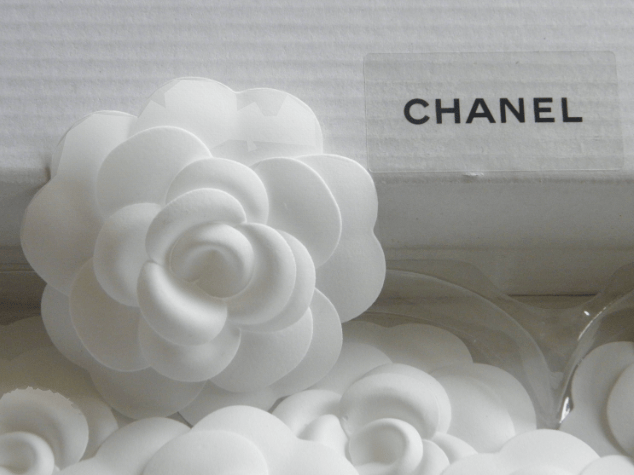
Among Chanel’s symbols, none is more quietly powerful than the camellia. It is not dramatic like Dior’s rose nor exotic like Poiret’s blooms. It is simple, symmetrical and un-mistakably modern — a flower without scent, without thorns, without excess. In choosing the camellia, Chanel chose a symbol that mirrored her own philosophy: purity without fragility, elegance without ornament, beauty without noise.
The camellia’s whiteness mattered. Chanel understood colour as intention and white carried a clarity she valued deeply. It revealed proportion, highlighted structure and softened silhouette without ever becoming sentimental. White was the colour of beginnings, of light, of the clean simplicity she believed fashion should embody. The camellia, rendered in white became her emblem of purity — not innocence but precision.
Chanel’s relationship with the camellia began long before it appeared on her garments. She admired its geometry: the perfect roundness of its petals, the balance of its form, the way it held shape without needing fragrance or colour. It was a flower that refused drama. It was, in its quiet way, architectural. Chanel saw in it the same qualities she sought in her designs — restraint, proportion and clarity.
When she began incorporating the camellia into her work, she did so with intention. It appeared on dresses, pinned to jackets, nestled into belts and later became a signature motif in jewelry and accessories. But Chanel never used the camellia as decoration. She used it as punctuation — a single, deliberate gesture that completed a look without overwhelming it. The camellia was not an embellishment; it was a philosophy made visible.
Its whiteness also connected to Chanel’s personal history. White was the colour of the convent where she grew up, the crispness of men’s shirts she borrowed, the simplicity of the seaside summers that shaped her aesthetic. Yet she never used white nostalgically. She used it to refine. The camellia, rendered in white became a symbol of her refusal to indulge in sentimentality. It was modern, clean and emotionally neutral — a flower that belonged to no season and no tradition.
The camellia’s power lies in its duality. It is soft but structured, feminine but disciplined, decorative but architectural. It embodies the balance Chanel mastered: the tension between purity and strength, simplicity and sophistication. In white, the camellia becomes a study in proportion — a reminder that elegance can be quiet, that beauty can be deliberate and that restraint can be more expressive than excess.
Today, the camellia remains one of Chanel’s most enduring icons. It appears in couture, in ready‑to‑wear, in fine jewelry, in fragrance packaging and in the rituals of the house itself. It is the flower that greets clients, adorns boxes and symbolizes the brand’s commitment to clarity and refinement. The camellia is not merely a motif; it is Chanel’s aesthetic distilled into a single, perfect form.
Chanel didn’t choose the camellia because it was pretty. She chose it because it was pure. And in her hands, the white camellia became not just a flower but an idea — a symbol of modern elegance, architectural beauty and the quiet power of restraint.
I’m Stacey Hobbs thanks for reading Face by Stace! Until next time.
do you feel fabulous today?
 Face by Stace