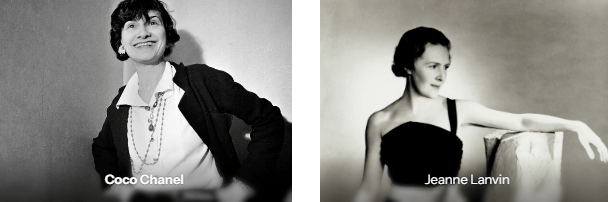
Paris in the early twentieth century was a city of glittering ambition — a place where couture was not merely clothing but currency, power, and identity. The salons were battlegrounds, the ateliers were kingdoms, and the women who ruled them were forces of nature. Among these queens, two stood tallest: Jeanne Lanvinand Gabrielle “Coco” Chanel. Their rivalry was not loud, but it was legendary — a quiet, simmering feud that shaped the very architecture of modern fashion.
Both women began as milliners, stitching dreams into hats for the Parisian elite. But their paths, though parallel, were forged from opposite temperaments. Lanvin was maternal, discreet, and devoted to beauty as a form of emotional nourishment. Chanel was sharp, un-sentimental, and determined to liberate women from the constraints of ornament and tradition. They were two visions of femininity — one romantic, one modern — colliding in the same city at the same moment.
The feud’s origins were rooted in proximity. Paris was too small for two rising empires. Lanvin’s early success, particularly her children’s wear and her aristocratic clientele, reportedly stirred Chanel’s jealousy. Chanel, who built herself from nothing, viewed Lanvin’s social connections and maternal image with a mix of disdain and envy. Lanvin, in turn, saw Chanel as a disruptor — brilliant, yes, but reckless, dismissive of the artistry couture had been built upon.
Their rivalry was not fought in public statements. It un-folded in gestures, in critiques whispered across salons, in the way clients aligned themselves with one house or the other. Parisian society divided itself between Lanvin’s romanticism and Chanel’s severity. Lanvin’s gowns floated; Chanel’s suits cut. Lanvin’s embroidery shimmered; Chanel’s jersey rebelled. Their aesthetics were not merely different — they were philosophical opposites.
Lanvin believed in beauty as devotion. Chanel believed in beauty as liberation. Lanvin dressed women as constellations. Chanel dressed women as individuals. Lanvin built a universe. Chanel built a revolution.
The tension between them was palpable. Critics compared them relentlessly. Clients gossiped. The press framed them as opposing poles of Parisian couture. And beneath it all, the two women watched each other — silently, strategically, competitively — as their empires grew.
By the 1920s, their feud had become part of the cultural fabric of Paris. Chanel’s modernism was ascendant, but Lanvin’s romanticism remained beloved. They were not friends. They were not collaborators. They were rivals — equal in power, opposite in philosophy, and bound together by the city that crowned them both.
Two milliners.
One city.
One feud that would define the century.
This is where the story begins.
I’m Stacey Hobbs thanks for reading Face by Stace! Until next time.
do you feel fabulous today?
 Face by Stace