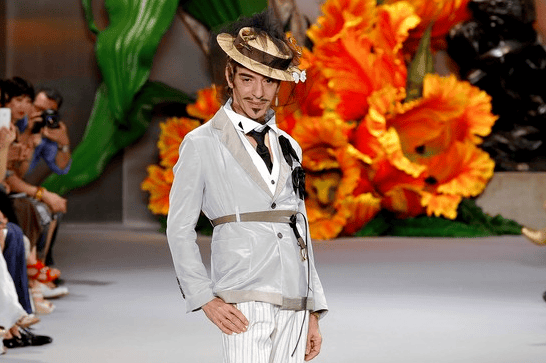
By the time John Galliano arrived at Dior in 1996, the house had lived through decades of elegance, restraint and continuity. Marc Bohan had kept the lights on. Gianfranco Ferré had restored architectural discipline. But Dior, to what Dior had been known for since Christian Dior debuted his 1947 New Look fashion and perfume, that Dior of shock, spectacle and cultural dominance had been sleeping. Until….
Galliano woke it up.
He didn’t tiptoe into the house.
He detonated into it.
From his very first couture show, it was clear of one thing: Galliano wasn’t interested in preserving Dior’s past. He was here to resurrect its spirit — the audacity, the drama, the fantasy that Christian Dior himself had un-leashed in 1947. But Galliano did it with a theatricality the world had not ever seen.
Galliano turned runways into worlds. Models into characters. Collections into stories.
One season, he transported audiences to the court of the Tsars. Another, to the streets of 1920s Paris. Another, to the imagined diaries of adventurers, muses and mythic heroines.
Galliano didn’t design clothes.
He staged epics.
And the world was practically hypnotized.
Under his direction, Dior became the beating heart of late‑90s and early‑2000s fashion — a house where couture wasn’t just craftsmanship but also cinema. His bias‑cut gowns, his impossible tailoring, his historical mash‑ups, his fearless excess… they re-defined what couture could be in a globalized, celebrity‑driven era.
He made Dior relevant again. He made couture dangerous again. He made fashion feel like magic again.
But Galliano bridged the gap between old‑world couture and the new world of pop-culture. Without Galliano, the fashion landscape that shaped the 2000s — and the artists who defined it — would look very different.
He was Dior’s next great disruptor. And like every disruptor in the house’s history, his brilliance came with shadows — a story for another chapter.
I’m Stacey Hobbs, thanks for reading. Until next time!
do you feel fabulous today?
 Face by Stace