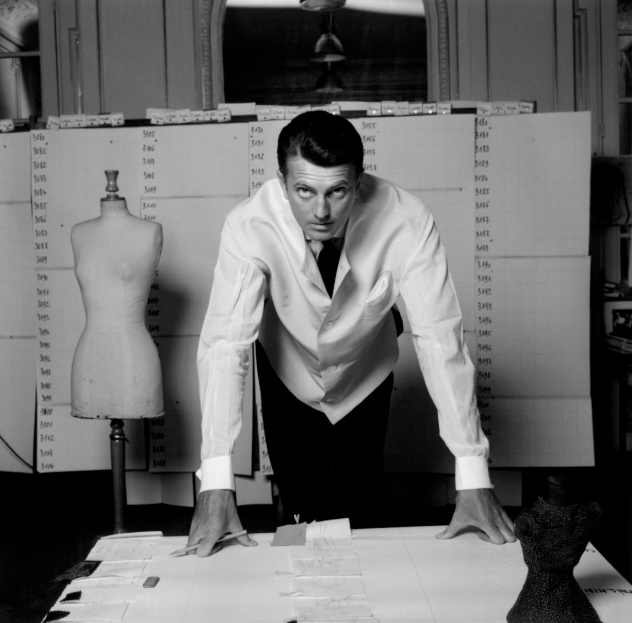
Before founding his own couture house in 1952, Hubert de Givenchy trained under Jacques Fath, Robert Piguet, and Elsa Schiaparelli. His years at Schiaparelli’s Place Vendome atelier shaped his eye for elegance and taught him the art of refined simplicity. Unlike many of his contemporaries, he never worked under Christian Dior, a detail that set him apart from the dominant post‑war couture lineage. That independence helped define the modern, architectural purity that became the signature of the House of Givenchy.
How a young couturier shaped his vision long before Audrey Hepburn stepped into his atelier.
Before Audrey Hepburn, before Sabrina, before the black dress in Breakfast at Tiffany’s, Hubert de Givenchy was a young designer quietly absorbing the lessons that would define his future house. His early career often over-shadowed by his later fame which reveals how a seventeen‑year‑old apprentice became one of the most influential couturiers of the 20th century.
This is the story of Givenchy before the legend.

1945:
The Apprenticeship Begins:
Jacques Fath
Givenchy entered the world of couture at just seventeen, joining the atelier of Jacques Fath, one of Paris’ most glamorous post‑war designers. Fath’s world was fast, modern and exuberant, a sharp contrast to the austerity of wartime fashion.
From Fath, Givenchy learned the importance of youthfulness, the power of clean, elongated lines and how to design for a modern, active woman.
It was his first glimpse of the elegance he would later refine.
1946:
A Brief but Formative Season with Robert Piguet
After Fath, Givenchy moved to Robert Piguet, known for impeccable taste and quiet sophistication. Piguet’s atelier was disciplined, restrained and deeply focused on silhouette.
Here, Givenchy absorbed the value of simplicity, the beauty of proportion and the art of letting fabric speak.
This balance of glamour (Fath) and purity (Piguet) would become the foundation of his style.
1947–1951:
Schiaparelli and the Place Vendôme Years
In 1947, Givenchy joined Elsa Schiaparelli, the most imaginative couturier of her era. Working in her Place Vendôme boutique, he designed for the “Schiaparelli Boutique” line, which was youthful, playful and accessible.
From Schiaparelli, he learned boldness without excess, the elegance of clarity and how to blend whimsy with refinement.
Her surrealism didn’t become his aesthetic but her fearlessness shaped his confidence.
This period in Givenchy’s career is crucial. Givenchy never worked for Christian Dior, making him one of the few major post‑war couturiers outside the Dior/Balmain/Lelong lineage. That independence would define him.
1952:
A House of His Own
At just twenty-four, Givenchy opened his own couture house which was a remarkable feat in a Paris dominated by giants. His debut “Separates” collection introduced crisp blouses, light skirts and inter-changeable pieces that felt fresh, modern and effortless.
It was a quiet revolution. And it set the stage for the moment that would change everything.
One year later, Audrey Hepburn walked into his atelier.
Why This Era Matters
Givenchy’s early years explain the purity and restraint that became his signature. Long before Hepburn, he was already forming the vocabulary of modern elegance:
- clean lines
- architectural silhouettes
- youthful ease
- refined simplicity
Givenchy’s rise was gradual that was shaped by the designers that came before him.
I’m Stacey Hobbs, thanks for reading. Until next time!
do you feel fabulous today?
 Face by Stace