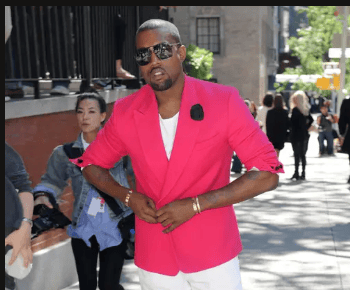
In the night, I hear them talk, the coldest story ever told … except this is a story that is anything but heartless!
Let’s rewind to the roots of where Kanye West, first merged streetwear with high fashion.
Kanye West didn’t stumble into fashion; he forced the industry to take him seriously. Long before Yeezy became a cultural phenomenon, he was already blending streetwear with luxury in ways the fashion world wasn’t prepared for or better yet, couldn’t ignore.
To understand how Kanye re-shaped modern fashion, it is important to go back to the moment he stopped dressing like a rapper and started dressing like a designer.
The Pink Polo Era:
When Kanye First Broke the Mold
Kanye West was already re-writing fashion rules, quietly and intentionally that is. And long before the industry took him seriously. In the early 2000s, hip‑hop style was dominated by oversized jerseys, baggy denim and a hyper‑masculine aesthetic. Kanye walked in wearing a pink Ralph Lauren polo and a Louis Vuitton backpack, and rap culture had begun to shift.
This wasn’t accidental. It was a statement.
Kanye was signaling that streetwear didn’t have to be sloppy and luxury didn’t have to be exclusive. He blended prep with hip‑hop, designer with everyday wear, and confidence with vulnerability. He dressed like someone who saw himself not just as a rapper, but as a creative director in the making.
The pink polo era was the first time the world saw Kanye’s fashion philosophy and that philosophy Kanye wore that stated, style as an expression of an identity. He was building a brand.
And the industry noticed.
Louis Vuitton Don: The First Luxury Co‑Sign
If the pink polo announced Kanye’s arrival, his Louis Vuitton era confirmed his ambition. Long before he became a designer in his own right, Kanye positioned himself as a luxury insider not by waiting for permission, not Kanye’s style but by positioning himself like he already belonged.
He called himself the Louis Vuitton Donbefore the fashion house ever acknowledged him. And that confidence some may refer to it as delusion; while others may view it as foresight. Kanye understood something the industry hadn’t caught up to yet: streetwear and luxury were on a collision course, whether Kanye realized it or not and let’s face it, he probably already predicted, he was the bridge to merge the two styles of fashion to intertwine them.
His early collaborations with Louis Vuitton in 2009 were more than celebrity merch. They were a cultural shift. For the first time, a rapper wasn’t just modeling luxury; he was actually designing it. The sneakers sold out instantly, signaling that the future of high fashion wasn’t in couture gowns — it was in the hands of artists who understood youth culture.
This was the moment the fashion world realized Kanye wasn’t playing dress‑up. Oh no, no. He was doing much more than that, far more. He was contributing to fashion, to fashion history. He was building a legacy.
The Nike Air Yeezy:
When Sneakers Became High Fashion
If Louis Vuitton proved Kanye could establish himself in the world of luxury, in the world of fashion, in the world of high-fashion, haute couture then the Nike Air Yeezy proved he could flip the entire table over. Before Kanye, sneakers were either performance gear or street staples not runway conversation pieces. But in 2009, the Air Yeezy changed the game.
This was the first time Nike had ever given a non‑athlete a signature shoe.
Kanye treated the sneaker like its couture: sculptural, futuristic, architectural. The Air Yeezy was strictly designed for the front row. And the fashion world stopped to take notice.
The release triggered lines around blocks, re-sale chaos and a cultural shift that still shapes sneaker culture today. Suddenly, sneakers had been escalated to status symbols, investment pieces and the new luxury. After all, Kanye West is a visionary; he saw what was missing in fashion and executed something he believed the world needed and the world was ready for it.
Yeezy Season:
The Runway That Changed Everything
By the time Kanye unveiled Yeezy Season 1 in 2015, he wasn’t just influencing fashion — he was reshaping its entire vocabulary. The show wasn’t a traditional runway; it was a cultural event. Models stood in formation like a living installation, dressed in muted tones, military silhouettes, and dystopian minimalism that felt more like performance art than fashion week.
Critics didn’t know what to do with it. But the culture did.
Kanye was designing clothes to impress editors, but more importantly, Kanye was more interested in designing clothes for what mattered most to him, that was more important and that is for a whole new generation. A generation that loved fashion, better yet, style as much as Kanye, himself. A generation that was able to view his art that he had expressed, managed to translate into his fashion as he had successfully completed in other artistically formats in his repertoire. A generation that had supported Yeezy Season One, instantaneously. West’s first collection consisted of oversized hoodies, distressed knits, sock‑fit boots, and earth‑tone palettes became the blueprint for an aesthetic that would dominate the next decade.
What made Yeezy Season revolutionary wasn’t just the clothing. It was the idea that fashion could be:
- unisex
- utilitarian
- sculptural
- stripped down
- emotionally charged
Kanye took the language of streetwear and elevated it to the level of conceptual art. And whether the industry wanted to admit it or not, the world followed.
Drop Culture: How Kanye Rewired the Hype Economy
Before Kanye, fashion releases followed a predictable rhythm: seasonal collections, runway previews, and slow rollouts. Then came Yeezy — and suddenly, the entire industry was operating on Kanye’s clock.
Kanye didn’t just design clothes; he engineered anticipation. He turned every release into an event, every sneaker into a cultural moment, every drop into a frenzy. Limited quantities, surprise announcements, and instant sell‑outs became the new norm — not just in streetwear, but across luxury fashion.
This wasn’t hype for hype’s sake. It was a new economic model.
Kanye understood that scarcity creates desire, and desire creates value. Brands from Dior to Balenciaga to Off‑White adopted the same strategy, proving that Kanye wasn’t following trends — he was building the blueprint.
Drop culture didn’t just change how we buy fashion. It changed how we experience it.
The Legacy Kanye Left on Fashion
Whether you admire him, like him, critique him, or dislike him, or sit somewhere in between, one truth is impossible to deny: Kanye West re-shaped modern fashion in a way no artist before him ever has. He blurred the lines between streetwear and luxury, turned sneakers into cultural aesthetics and built a design language that influenced everyone from high‑end houses to fast‑fashion retailers.
Kanye wasn’t going to wait for the fashion world to open its doors. Instead he walked in, re-arranged the furniture and re-wrote the rules.
From the pink polo to Louis Vuitton, from Nike to Adidas, from runway installations to drop culture, his impact is woven into the fabric of what we now call contemporary style.
Kanye had influenced multiple forums and that includes but not limited to fashion, as it is influenced everywhere.
This isn’t a story. It’s an examination of cultural impact — and Kanye West’s influence on fashion remains one of the most significant of our time.
I’m Stacey Hobbs, thanks for reading. Until next time!
do you feel fabulous today?
 Face by Stace