Hey, everyone, and welcome back to part four of 25 forgotten beauty secrets women in the 1950s part 4!
It is so fascinating to discover or re-discover beauty secrets from the 1950s, specifically with women. From Pond’s Cold Cream and Vaseline petroleum jelly, such as did you know Kleenex facial tissue was invented in 1924, by Kimberly-Clark through the global phenomenon of Pond’s Cold Cream? How about additional inventions through the miracle in a jar, Pond’s Cold Cream, which include, in addition to the invention of Kleenex facial tissue, but not limited to, cream-based cleansers and cleansing balms that evolved from Pond’s Cold Cream? And Vaseline petroleum jelly? Oh, and those Old Hollywood icons from Marilyn Monroe, to Jackie Kennedy in her early years, and more of whom relied on Pond’s Cold Cream as a “primer” and for everything, even though they had their skin-care doctor to prescribe high-end luxury products, as well as Vaseline as another primer option. Marilyn Monroe’s make-up artist applied Vaseline before make-up application, whether its for film, photo-shoots or whichever. On film it delivered a natural glow, if you will. Check 25 forgotten beauty secrets women in the 1950’s part 1!
Check out part two, discover Joan Crawford’s pore tightening secret, her infamous ice water facials; Do you want to take a bath like Marilyn Monroe? Then you’ll love to re-create her documented ice bath; pin curls; sleeping in pin curls and why women resorted to this method; silk (and satin) pillowcases, how to refrain from waking up with “the frizz” or “bedhead frizz”; hair; vinegar, lemon juice and beer hair rinse; and why the ladies of 1950s relied on hair rinses. Rainwater, anyone?
Enjoy part three, household skin-care remedies (Aspirin Masks, Witch Hazel and Baking Soda), homemade hair masks and conditioners (egg, mayo and olive oil treatments and Rita Hayworth’s documented hair treatment!), cold spoons for de-puffing the eyes, scalp oiling & packing (Black hair-care) and Aerosol Hairspray.
In this section of part four, Hair Accessories and Ornaments (Ribbons, Flowers and Combs), 1950s make-up look, nail care and Max Factor Pan-Cake Make-up.
Hair Accessories and Ornaments:
Ribbons, Flowers and Combs
Hair accessories completed the 1950s look, with ribbons, flowers, jeweled combs and headbands adding a touch of femininity and flair.
Women of the 1950s used hair accessories to look perfectly polished. Accessories matched the era’s structured, ultra-feminine hairstyles. Women valued coordinated, neat looks for every occasion.
Ribbons and Headbands
Satin ribbons were tied around high ponytails, while Velvet bands kept short poodle cuts neat. Chiffon scarves were wrapped loosely over bouffants and gingham bows matched causal Summer playsuits.
Hair Flowers
Faux blossoms were placed over side-swept rolls. Tropical orchids were paired with popular tiki culture. Rose clips were tucked behind the ears for romance, while flower wreaths were worn over structured crown curls.
Decorative Combs
Rhinestone combs were secured in evening up-dos elegantly. Tortoiseshell slides were held back in daytime French twists. Lucite prongs were featured in colourful, marbled designs. Pearl teeth were accentuated formal bridal hairstyles beautifully.
Face Powders, Blotting Techniques and
Compact Culture
Pressed powder compacts were both a beauty essential and a fashion accessory. Women carried ornate compacts for touch-ups, using blotting papers to control shine throughout the day.
1950s face powder culture prioritized a flawless, velvet-matte finish. A shine-free, “porcelain” complexion was the standard of beauty, making the public application of powder a major social ritual.
After the application of foundation, loose or pressed powder was used to set make-up and to mattify the skin. Blotting papers absorbed excess oil, preserving the flawless matte finish. No different than the present.
Today, this is how loose or pressed powder needs are in make-up application, the same goes for blotting papers. All for the same reason as the 1950s.
The Compact Culture
- Status symbols: Women collected jewelled, enameled and sterling silver compacts.
- Luxury brands: Stratton, Elgin American, and Evans dominated the high-end market.
- Social ritual: Powdering your nose in public was a stylish, accepted gesture.
- Music boxes: Some novelty compacts played tunes when opened at parties.
- Convertible wells: Designs held loose powder or fitted specific pressed powder pans.
Face Powder Trends
- Max Factor Pan-Cake: This heavy, water-activated base ruled the early 1950s.
- Coty Airspun: A lighter, loose powder used to set liquid foundation.
- Matching undertones: Powders highlighted peaches-and-cream or warm rosy skin tones.
- Velour puffs: Large, plush puffs were essential to press powder into skin.
Blotting Techniques
- Linen tissues: Women pressed specialty linen sheets firmly against the
T-zone. - Powder pounding: Puffs pressed fresh powder over oil instead of wiping it.
- Restoration ritual: Blotting always preceded reapplying powder to prevent cakey buildup.
- Handkerchief shields: Cotton cloths protected structured collars during daytime touch-ups.
Hand Care, Nail Polish Trends and
Cutex Practices
Cutex and Revlon dominated the nail polish market, offering a range of reds, pinks and pastels. Manicured hands were a symbol of elegance, with regular moisturizing and cuticle care as part of the routine. Pastel was a common colour theme of the decade, from make-up to home decorations, such as kitchen appliances, as well.
Nails were filed into oval or rounded shapes, cuticles pushed back and nail polish applied in two coats with a glossy topcoat. Matching lips and tips was a popular trend.
Nail Polish Trends
Nail polish trends of 1950s women consisted of four big trends. These trends were: Almond shapes maintained long, rounded, elegant contours. Bold reds dominated daily glamour. Frosted pinks provided soft, pearlescent shimmer choices. Half-moon manicures left the base lunula bare.
Hand Care Routines
Hand care routines were warm soaking, careful filing, base coats, thin layers and protective gloves.
- Warm soaking: Softened rough cuticles before trimming.
- Careful filing: Smoothed edges to prevent snagging.
- Base coats: Shielded beds from deep staining.
- Thin layers: Ensured even, chip-resistant drying.
- Protective gloves: Shielded pristine polish during chores.
Presently, gel polishes, nail art and professional manicures offer endless possibilities. The classic 1950s palette remains a favourite option for those seeking a timeless, feminine look.
Eyebrow Shaping and Pencil Techniques

1950s eyebrows were arched, or pointed, the techniques created a bold, thick and highly structured look. Departing from the utra-thin lines of the 1930s, to adopt a defined, high-angled arch that beautifully framed the eyes, the face and over all balanced the era’s heavy Pan-Cake foundation and vivid red lips.
Regardless of natural hair color, brows were filled in deep and dark.
Tweezing & Shaping Rules
- Strict neatness: The space below the arch was plucked entirely bare to highlight the brow bone.
- Minimal top plucking: Tweezing occurred mostly from underneath to preserve natural thickness.
- Petroleum jelly finish: A swipe of Vaseline kept hairs lying perfectly flat all day.
Old Hollywood Icons Inspirations
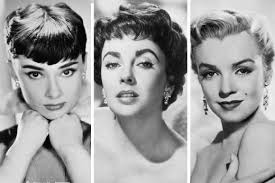
Audrey Hepburn: Made the straight, thick and heavily filled “boyish” brow incredibly popular.
Marilyn Monroe: Set the standard for the ultra-sharp, highly pointed arch.
Elizabeth Taylor: Championed naturally dark, framing, and commanding buxom brow contours.
Max Factor’s Pan-Cake Make-up


Max Factor’s water-activated Pan-Cake makeup was the defining foundation for women in the 1950s.
1950s women seeking a flawless, full-coverage look. Originally designed for Hollywood’s Technicolour film sets, it quickly transitioned into a daily beauty staple, selling tens of millions of units throughout the decade.
Hollywood Roots
- Technicolor solution: Developed to stop studio light glare.
- Massive popularity: Millions of everyday women bought it.
- Old Hollywood glam: Promised a screen-star complexion.
- Shade range: Offered warm peach and pink undertones.
The Application Process
- Damp sponge: Women activated the dry cake with water.
- Swift blending: The formula dried incredibly fast.
- Oily skin savior: Resisted sweat and mid-day melting.
- Drying nature: Required heavy pre-moisturizing creams.
The Mask Effect
- Opaque coverage: Concealed all blemishes and freckles completely.
- Velvet-matte finish: Left zero shine on the face.
- Porcelain canvas: Allowed bold red lipsticks to pop beautifully.
- Colour shift: Dried slightly lighter than the wet cake.
Iconic Actresses Who Swore By It
Before Pan-Cake was invented, early film make-up highly reflected background colours. If an actress stood near red curtains, she looked sunburned on screen. Major Golden Age icons actually refused to shoot in colour until Pan-Cake solved this glare. Old Hollywood icons that loved Max Factor Pan-Cake make-up, this includes but not limited to Greta Garbo, Betta Davis, Norma Shearer, Betty Grable, Loretta Young, Judy Garland, Claudette Colbert and Joan Crawford.
Claudette Colbert had a custom shade named “Dark”, which was made specifically for her skin tone by Max Factor.
Did Men Wear It Too?
Actors like Charlie Chaplin, Buster Keaton, and Rudolph Valentino wore Max Factor’s base formulas to standardise their complexions under intense studio light bulbs.
(Note: While Marilyn Monroe is often tied to Max Factor, her favourite product was actually the later, creamier spin-off called Pan-Stik, rather than the water-activated cake.)
For more on Max Factor, his innovations, the history of the Father of Make-up, check it out!
Salon Culture:
Weekly Visits and Professional Etiquette
Regular, weekly salon visits were a social ritual, with women gathering for weekly shampoos, sets and styling. Salons were centers of community, gossip and self-care, with strict standards for hygiene and technique.
Women booked standing appointments for their preferred styles, often spending hours under hood dryers or receiving perms. Professional stylists were trained in pin curls, roller sets, and chemical treatments.
More on salon culture in America, Europe, Paris and Canada in the 20th century, stay tuned!
The Influence of Advertising, Magazines and Hollywood

The 1950s beauty landscape was shaped as much by cultural forces as by products and techniques. Hollywood stars like Marilyn Monroe, Grace Kelly, and Elizabeth Taylor set trends that women across America rushed to emulate. Magazines and advertisements played a pivotal role, offering step-by-step guides, product recommendations, and aspirational imagery.
Advertising campaigns—such as Revlon’s “Fire and Ice”—redefined beauty as a form of self-expression, not just a means to attract men. Beauty brands competed fiercely, introducing new shades, formulas, and packaging to capture the imagination of consumers. The rise of television brought beauty tutorials and product endorsements into living rooms, further democratizing access to the latest trends.
I’m Stacey Hobbs, thanks for reading. Until next time!
do you feel fabulous today?
 Face by Stace