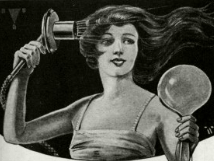
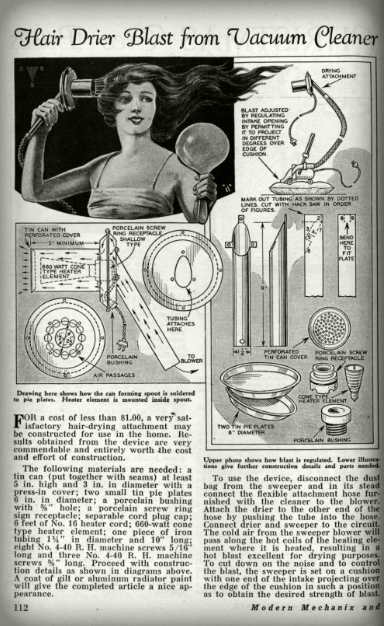
The 1920s blow dryer is one of the most fascinating intersections of beauty, fashion, and early technology. Before this decade, drying hair meant sitting under a gas‑heated hood in a salon—a bulky contraption invented in 1890 that looked more like industrial plumbing than beauty equipment. But by 1920, advances in small electric motors finally made it possible to hold a dryer in one hand, and companies like National Stamping & Electric Works and Hamilton Beach introduced the first consumer models.
These early dryers were nothing like the sleek tools we know today. They weighed nearly a kilogram, produced only about 100 watts of heat, and took a long time to dry the hair. Their airflow was weak, their motors overheated, and electrocution was a genuine risk. Yet women embraced them because they represented freedom: the ability to style hair at home rather than relying solely on salon visits.
Visually, 1920s dryers were stunning. Their chrome bodies, metal vents, and geometric shapes reflected the era’s obsession with machinery and modernity. They looked like miniature robots—part Art Deco, part post‑WWI futurism—capturing the excitement of a world stepping boldly into the age of electricity.
Despite their flaws, these dryers changed beauty culture. Shorter 1920s hairstyles dried faster, making the blow dryer a symbol of the modern woman: efficient, stylish, and technologically empowered. The 1920s blow dryer wasn’t just a tool—it was a cultural shift, marking the moment beauty embraced innovation.
I’m Stacey Hobbs, thanks for reading Face by Stace! Until next time.
do you feel fabulous today?

