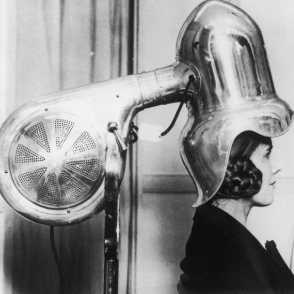
The early hood dryer of the late 1920s and 1930s represents one of the most important turning points in salon history. Before this invention, drying hair meant sitting beneath gas‑heated hoods from the 1890s or navigating the chaotic airflow of multi‑nozzle machines. The hood dryer changed everything by enclosing the head in a single, helmet‑like chamber that delivered consistent, controlled heat. For the first time, stylists could dry hair evenly without disturbing the sculpted shapes of finger waves, Marcel sets, or the sleek flapper bob.
Clients sat upright beneath the heavy metal hood, connected to a large fan or motor positioned behind the head. The machine circulated warm air throughout the chamber, reducing drying time and improving styling precision. This uniform heat distribution made the hood dryer far more efficient than earlier devices, transforming salon workflow and elevating the quality of finished styles.
Visually, the early hood dryer embodied the industrial elegance of the era. Its metallic shell, exposed screws, and mechanical base reflected the 1930s fascination with engineering and modernity. It looked like a hybrid between a beauty tool and a laboratory device, yet it quickly became a staple in salons across North America and Europe.
The early hood dryer paved the way for the rigid‑hood dryers of the 1950s and the plastic home bonnet dryers of the 1960s. It represents the moment when drying technology became standardized, reliable, and central to professional hairdressing. In the evolution of beauty machinery, the early hood dryer stands as the first truly modern salon dryer.
I’m Stacey Hobbs, thanks for reading Face by Stace! Until next time.
do you feel fabulous today?

