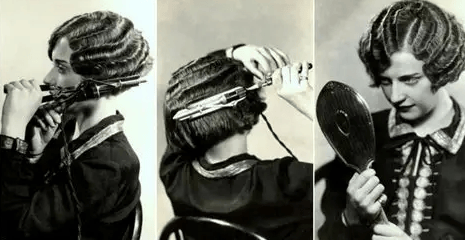
The Marcel wave iron is one of the most defining beauty tools of the 1920s—an instrument that shaped the flapper era as much as fashion, film or jazz. Invented in the late 19th century by French hairdresser François Marcel, the iron became essential in the 1920s when women embraced sculpted, S‑shaped waves that framed the face with elegance and precision. These waves were not accidental; they were engineered with heat, skill and a tool that demanded respect.
A true Marcel iron was a manual hot iron, heated over a stove or spirit lamp. It featured two long metal tongs with a curved barrel and wooden handles that protected the stylist’s hands from extreme heat. Unlike modern curling irons, Marcel irons had no electrical cord. Stylists controlled temperature by touch, experience and intuition—too cool and the wave wouldn’t hold; too hot and the hair could scorch instantly. Many stylists kept multiple irons heating at once, rotating them rapidly to maintain the perfect working temperature.
The technique itself was an art form. Stylists clamped, twisted, and shaped the hair into rhythmic S‑curves, creating the iconic finger wave pattern that defined 1920s glamour. Silent‑film stars, chorus girls and fashionable socialites all relied on Marcel irons to achieve the sculpted, glossy waves that photographed beautifully under studio lights.
Though eventually replaced by electric irons and modern waving tools, the Marcel iron remains a symbol of craftsmanship. It represents a moment when hairstyling was both technical and theatrical—an era when beauty was shaped by hand, heat and mastery.
I’m Stacey Hobbs, thanks for reading Face by Stace! Until next time.
do you feel fabulous today?

