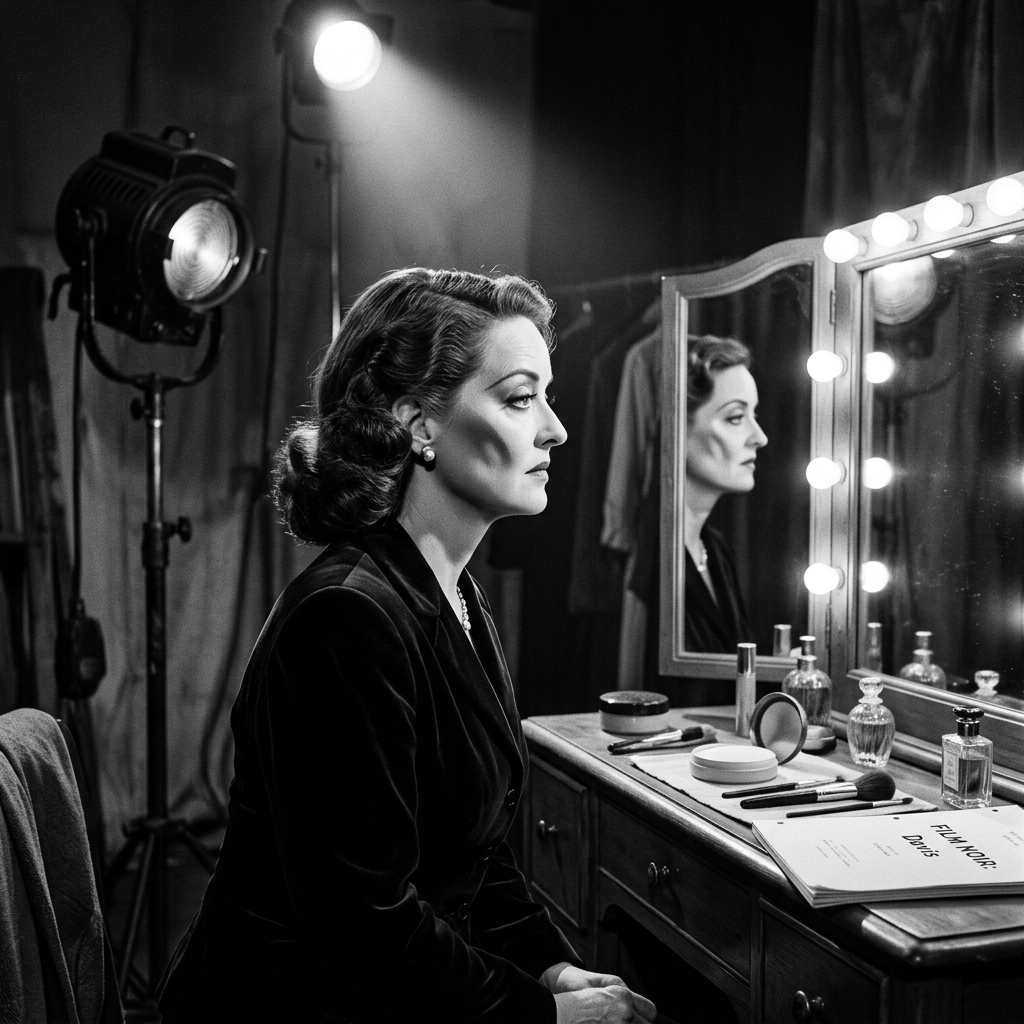
Bette Davis understood that lighting wasn’t just technical — it was transformative. Her cheekbones, already naturally defined, became razor‑sharp on screen because she mastered the art of angle‑based lighting long before actors were expected to know such things. Davis treated light like a sculptor treats clay, using it to carve, lift, and intensify her bone structure.
She worked closely with cinematographers, insisting on specific setups that enhanced the planes of her face. Key lights were angled slightly above and to the side, creating shadows that deepened her cheek hollows. Fill lights were kept minimal, allowing contrast to remain dramatic. This technique gave her face a chiseled, almost architectural quality — perfect for the fierce, emotionally charged roles she dominated.
Davis also understood how to position herself. She tilted her chin subtly downward to sharpen the jawline, then turned her head just enough to let the light catch the cheekbone ridge. These micro‑movements became part of her performance style, adding tension and intensity to her close‑ups. She didn’t wait for the camera to flatter her — she engineered the shot.
Makeup played a supporting role. Davis used shading powders to reinforce the natural angles of her face, applying them with a light hand so the contour worked with the lighting rather than against it. The result was a face that looked sculpted, expressive, and unmistakably hers.
Her cheekbones weren’t just genetics. They were strategy — shaped by shadow, sharpened by light, and perfected through discipline.

