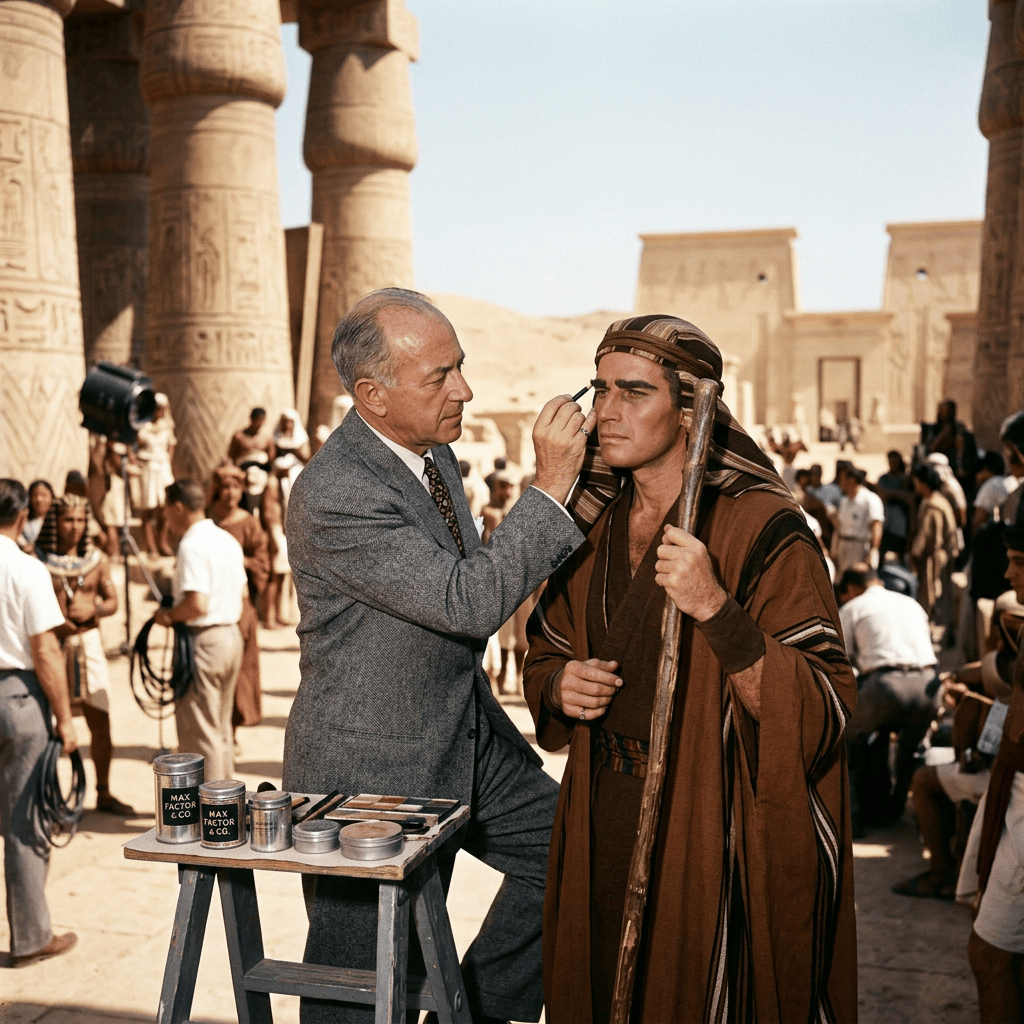
When The Ten Commandments premiered in 1956, it was one of the most ambitious films ever produced. Directed by Cecil B. DeMille, the biblical epic featured enormous sets, thousands of costumes, and a star‑studded cast led by Charlton Heston as Moses, Yul Brynner as Rameses, and Anne Baxter as Nefretiri. [imdb.com], [imdb.com]
Behind the grandeur was the continued influence of the Max Factor organization. By the 1950s, Hollywood makeup had become highly specialized, particularly for colour films. Records from the production credit Max Factor Jr. as makeup supervisor for Egyptian makeup, highlighting the company’s involvement in helping create the film’s distinctive ancient Egyptian aesthetic. [imdb.com], [tvguide.com]
This was a significant challenge. Under Technicolor photography, makeup had to appear believable on screen while still conveying the luxury, power, and drama of the Egyptian court. Every detail, from complexions to eye definition, needed to withstand intense studio lighting and close‑up cinematography. The polished appearance of characters such as Nefretiri and the royal court reflected decades of Hollywood makeup innovation pioneered by the Factor family. [imdb.com]
What makes The Ten Commandments especially important in beauty history is its blend of spectacle and glamour. Unlike contemporary films focused on everyday realism, this production demanded larger‑than‑life beauty that still appeared elegant on screen. The expertise developed by Max Factor for motion pictures helped make that balance possible. [imdb.com], [tvguide.com]
More than a biblical epic, The Ten Commandments showcased how Hollywood makeup had evolved into an art form capable of bringing entire civilizations to life.

