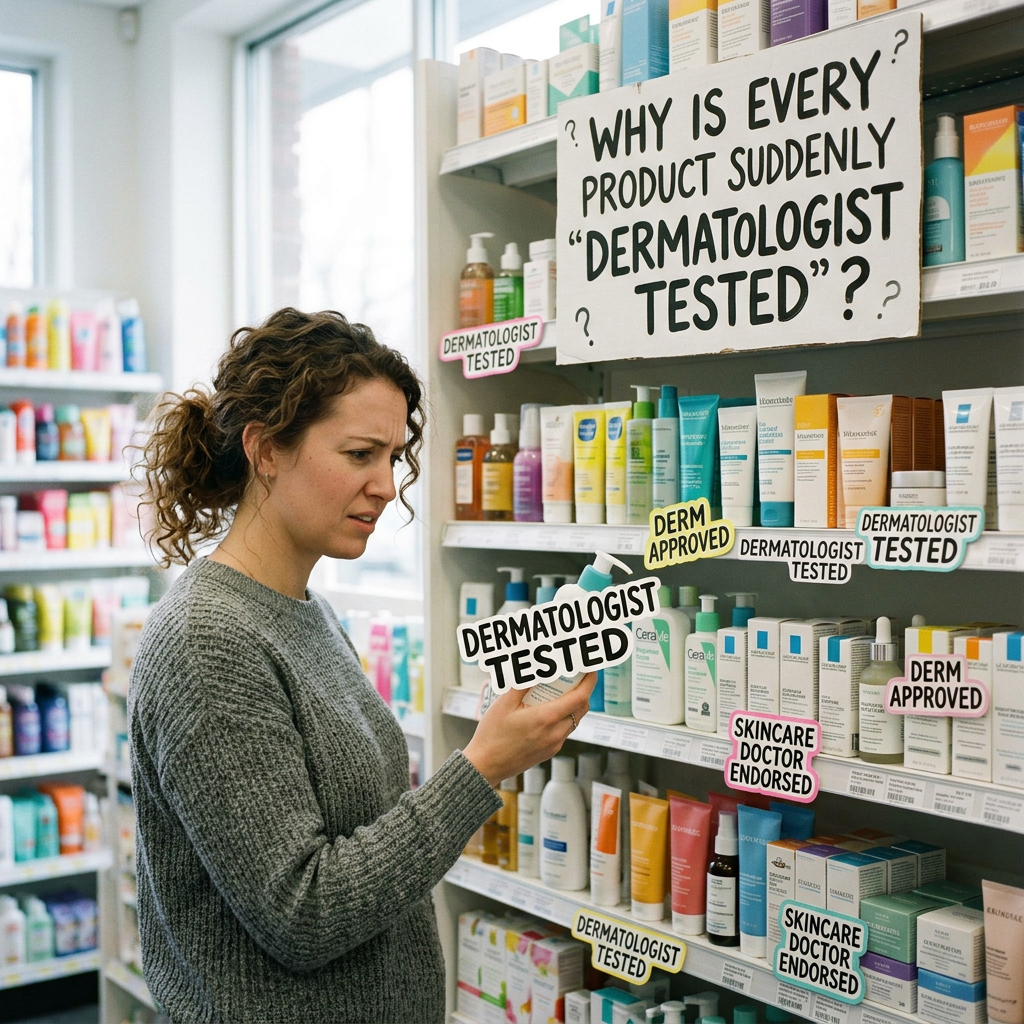
The Beauty Industry Under the Microscope
Walk through any beauty aisle, browse a skincare website or scroll through social media and you’ll notice a phrase appearing with remarkable frequency:
Dermatologist Tested.
It’s on cleansers, moisturizers, serums, sunscreens, shampoos and even cosmetic products. The phrase has become one of the beauty industry’s favourite credibility signals.
But what does it actually mean?
And perhaps more importantly, why is every brand suddenly using it?
The answer may surprise consumers.
At first glance, “dermatologist tested” sounds reassuring. Most people naturally associate dermatologists with expertise, scientific evaluation, and skin health. Seeing the claim on a product creates the impression that it has undergone rigorous scrutiny before reaching store shelves.
Yet the phrase itself can be more complicated than it appears.
Many consumers assume that dermatologist tested means dermatologist approved. Others believe it guarantees safety, effectiveness, or suitability for sensitive skin.
Those assumptions aren’t necessarily accurate.
In its simplest form, dermatologist tested generally means that a dermatologist was involved in some stage of product testing. What it does not automatically tell consumers is how extensive that testing was, how many participants were involved, what was evaluated, or what results were obtained.
That’s where much of the confusion begins.
The phrase sounds highly specific, yet the details behind it are often less visible than the claim itself.
So why has dermatologist tested become such a powerful marketing tool?
Part of the answer reflects changing consumer behaviour.
Today’s beauty shoppers are more ingredient-literate and more research-oriented than previous generations. Consumers are reading labels, learning about active ingredients, and asking more questions about safety and efficacy. Brands understand that scientific language can help build trust in an increasingly crowded marketplace.
Terms such as clinical, dermatologist tested, expert approved, and scientifically developed have become valuable shortcuts for communicating credibility.
At the same time, consumers have become more cautious.
Years of viral beauty trends, aggressive product launches, and conflicting skincare advice have encouraged many shoppers to seek reassurance before trying something new. Claims that suggest professional oversight naturally appeal to that desire for confidence.
None of this means dermatologist testing lacks value.
Professional involvement can be meaningful. Testing can provide useful information about irritation potential, skin compatibility, and overall product performance.
The challenge is that the phrase alone does not tell the whole story.
As consumers, we often focus on the presence of the claim rather than the context behind it.
Perhaps the better question isn’t whether a product is dermatologist tested.
Perhaps it’s what we hope that phrase means.
Are we looking for proof of safety?
Evidence of effectiveness?
Professional endorsement?
Or simply reassurance that we’re making the right choice?
The popularity of dermatologist-tested skincare reveals something fascinating about modern beauty culture.
Consumers aren’t just buying products anymore.
They’re buying confidence.
And in an industry built on promises, few words inspire confidence quite like dermatologist tested.
The question is whether we’re paying enough attention to what those words actually tell us.

