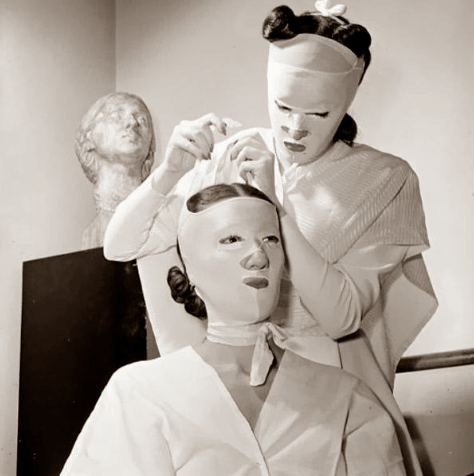
In the 1930s, beauty innovation often walked a fine line between science and spectacle — and few treatments captured that spirit better than the contouring mask. Popularized in elite salons like Helena Rubinstein’s Fifth Avenue location, these sculptural facial devices promised to “reshape” and refine a woman’s features through pressure, heat and strategic molding.
The mask itself looked almost futuristic: a rigid form fitted tightly over the face, designed to press the skin into sharper angles and more defined contours. Women reclined in salon chairs as attendants secured the mask and paired it with luxurious treatments — compressed air baths, milk-infused bubble soaks and other indulgent rituals meant to enhance the mask’s sculpting effect.
The idea was simple, even if the method was extreme: beauty could be engineered. In an era fascinated by modernity, machinery and the promise of transformation, the contouring mask became a symbol of the decade’s belief that technology could perfect the human face.
While today’s contouring relies on makeup, light and technique, the 1937 mask reminds us that the desire for sculpted cheekbones and refined features is nothing new. It’s simply evolved from rigid metal molds to the artistry of cosmetics.
The contouring mask stands as one of the most striking examples of early beauty innovation: bold, bizarre, and undeniably glamorous in its own mechanical way.
I’m Stacey Hobbs, thanks for reading Face by Stace! Until next time.
do you feel fabulous today?

