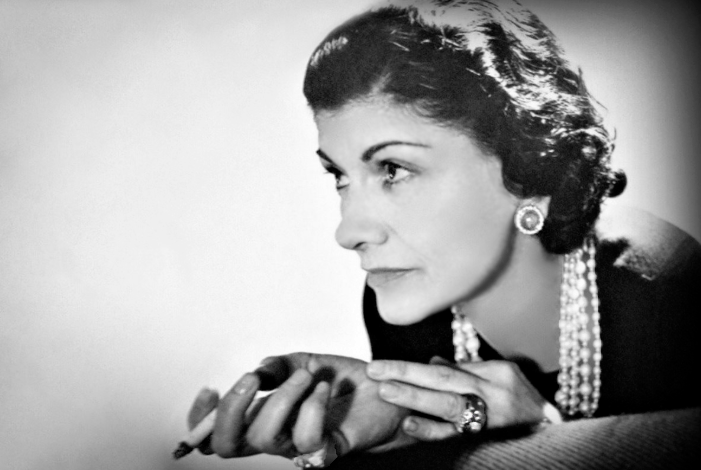
The couture house was only half her empire — the other half was the avant‑garde.
Long before Chanel became a global symbol of luxury, she was something far more interesting: a woman at the centre of Paris’s artistic vanguard. Her salon on the Rue Cambon was not just a fashion headquarters — it was a crossroads where painters, composers, poets, dancers and modernists collided.
Chanel didn’t simply dress artists. She collaborated with them. She influenced them. And she allowed their ideas to reshape her own.
Her circle was a constellation of geniuses.
Pablo Picasso: The Architect of Modern Vision
Picasso and Chanel were not lovers, but they were deeply connected through the Ballets Russes and the modernist movement. Chanel admired Picasso’s ability to fracture reality and rebuild it through geometry — a sensibility that echoed her own discipline of line, proportion and restraint.
Picasso saw Chanel as more than a couturier. He saw her as a designer with a painter’s mind.
Their conversations were famously sharp, intellectual and un-sentimental — two modernists dissecting the world through form.
Igor Stravinsky: The Composer Who Changed Her Life
Stravinsky entered Chanel’s orbit during the creation of The Rite of Spring, a work that shattered classical music and scandalized Paris. Chanel adored his audacity — the way he broke rules with elegance rather than chaos.
Their relationship became personal when Chanel invited Stravinsky and his family to live in her villa, Bel Respiro, during a difficult period in his life.
It was a friendship built on:
- discipline
- innovation
- mutual respect
- and the shared belief that beauty required courage
Stravinsky’s modernism influenced Chanel’s own evolution — especially her move toward sharper silhouettes and architectural simplicity.
Jean Cocteau: The Poet Who Understood Her Best
Cocteau was the closest to Chanel emotionally and intellectually. He saw her as a woman who designed with the precision of a mathematician and the imagination of a poet.
Their friendship produced some of Chanel’s most important artistic collaborations:
- Antigone (1922)
- Orphée
- Le Train Bleu for the Ballets Russes
Cocteau’s surrealism seeped into Chanel’s jewelry, her motifs and her fascination with symbols. Chanel’s discipline refined Cocteau’s theatrical minimalism.
They were creative mirrors — each sharpening the other.
Chanel’s genius wasn’t only in her designs. It was in her ability to absorb the energy of the avant‑garde and translate it into fashion.
Picasso gave her abstraction.
Stravinsky gave her rhythm.
Cocteau gave her symbolism.
Together, they shaped the Chanel aesthetic:
- clean lines
- modern geometry
- emotional restraint
- intellectual elegance
Chanel didn’t just dress the modern woman — she dressed the modern mind.
I’m Stacey Hobbs, thanks for reading Face by Stace! Until next time.
do you feel fabulous today?
 Face by Stace