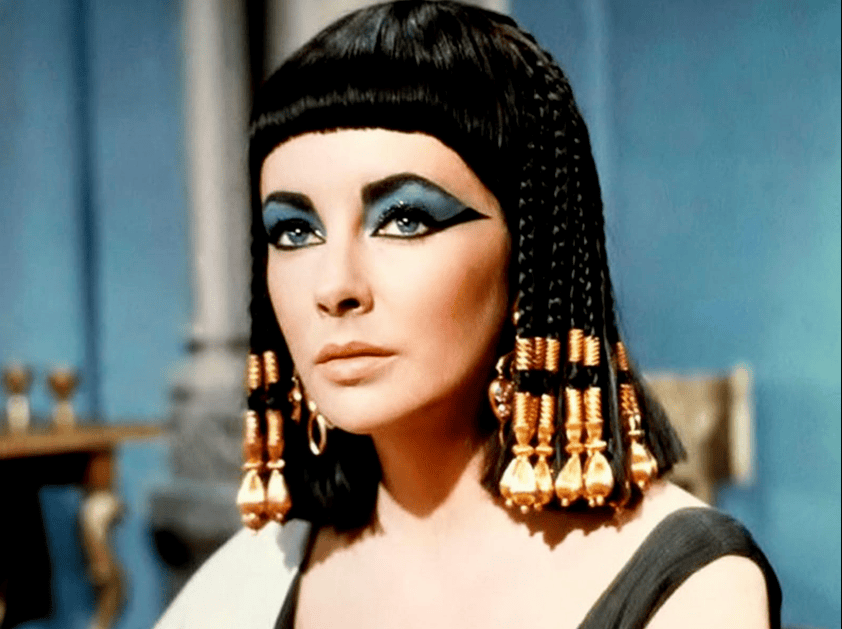
Elizabeth Taylor didn’t just wear the cat eye; she defined it. Long before the look became a 1960s beauty staple, Taylor’s almond‑shaped, violet eyes were framed by a dramatic, elongated liner that became her signature. While the cat eye make-up look existed in Hollywood before her, Taylor transformed it from a make-up technique into a cultural archetype.
Presently, cat eye make-up look is now referred to as winged liner.

While she did not invent the cat eye, Taylor’s version became one of the most recognizable and influential interpretations of the look in 1950s Hollywood. Her eyes, which are naturally almond‑shaped, framed by double lashes made the style iconic.
Taylor was wearing a softened, elongated liner as early as the mid‑1940s including during National Velvet (1944). The cat‑eye trend didn’t explode into mainstream beauty until Cleopatra in 1963.
Taylor had several make-up artists, her make-up artists especially during the MGM years emphasized her eye shape with a lifted, smudged pencil line. This became a defining feature of her screen persona.
Actresses like Hedy Lamarr, Greta Garbo, and Marlene Dietrich used early forms of the cat eye look in the 1930s–1940s. But their versions were softer, smokier and less codified.
This is accurate as a cultural statement with her cat eye that became instantly recognizable, tied to her persona, widely emulated, and foundational to the late 1950s and late 1960s make-up look and beauty aesthetics.
The Origins:
A Face Made for the Cat Eye
Taylor was born with a double row of eyelashes, called distichiasis and natural violet-blue eyes that shifted with lighting, these two rare genetic traits contributed to her beauty.
These features created a naturally shadowed, feline look. MGM make-up artists quickly realized that a winged liner amplified her eye shape better than any other style.
The Cleopatra Effect (1963):
The Cat Eye Goes Global

The cat eye became legendary during the filming of Cleopatra. Elizabeth Taylor’s primary make-up artist for Cleopatra, Alberto de Rossi built the look around thick kohl, extended wings, graphic Egyptian lines and bold shadow blocks.
This look from Cleopatra became a worldwide beauty trend. After Cleopatrapremiered eyeliner sales skyrocketed, beauty magazines published “Cleopatra eye” tutorials and the cat-eye became the defining make-up trend of the 1960s.
Taylor didn’t invent this eyeliner look however she originated the modern cat‑eye aesthetic that women still copy today.
Her Signature Technique
Taylor’s personal make-up routine (confirmed by her longtime make-up artist, Francesca Tolot) included:
- a thick, smudged pencil line along the upper lash line
- a lifted outer flick to elongate the eye
- darkened waterlines for intensity
- multiple coats of mascara to emphasize her double lashes
She preferred soft kohl pencils as opposed to liquid liner which is why her cat eye always looked smoky, sensual and slightly imperfect.
Why Elizabeth Taylor’s Cat Eye Endures
Her version of the cat eye became iconic because it was feminine but powerful, exotic but wearable, dramatic but timeless and it was rooted in her natural features, instead of it being just a trend.
Unlike the sharp, graphic wings of later decades, Taylor’s cat eye was lush, smoky and romantic, a look that still feels modern.
The Legacy
Today, when make-up artists reference “Cleopatra eyes” or “the classic cat eye” they are referencing Elizabeth Taylor’s cat-eye, her influence spans 1950s glamour, 1960s mod beauty, modern red‑carpet make-up, editorial fashion looks and everyday winged liner tutorials.
Elizabeth Taylor made the cat-eye iconic.
I’m Stacey Hobbs, thanks for reading. Until next time!
do you feel fabulous today?
 Face by Stace