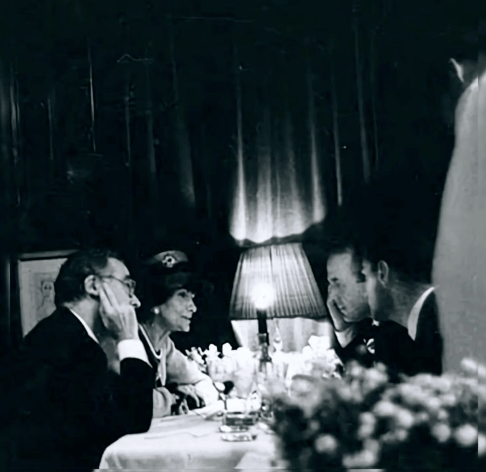
Chanel and Balenciaga stand as two of the most influential forces in twentieth‑century fashion, each re-shaping the industry through entirely different philosophies. Their legacies continue to define how designers think about silhouette, structure and the purpose of clothing.
Chanel approached design through reduction. Her work was built on clarity, comfort and a belief that elegance should feel natural. She stripped away excess, favouring clean lines, soft fabrics and a sense of ease that allowed women to move freely. Her suits, jersey dresses and understated accessories were not about spectacle — they were more about liberation. Chanel’s method was to simplify until only the essential remained.
Balenciaga worked in the opposite direction. His designs were architectural, sculptural and technically complex. He re-shaped the body through volume, structure and form, creating silhouettes that challenged traditional ideas of proportion. Where Chanel softened, Balenciaga sharpened. Where Chanel removed, Balenciaga constructed. His work demonstrated how fabric could be engineered not just draped.
Both designers changed fashion but through different means. Chanel offered a new kind of modernity rooted in ease. Balenciaga offered a new kind of modernity rooted in innovation. Chanel made elegance accessible; Balenciaga made elegance structural.
Their methods diverged, yet their impact converges in the way contemporary fashion continues to balance simplicity with experimentation. Chanel and Balenciaga remain two masters whose contrasting approaches still shape how we understand style today.
Chanel: Designing With Her Hands
Chanel did not sketch. She did not begin with a drawing or a theoretical silhouette. Her design process was tactile, instinctive and grounded in the physical reality of the body. She draped fabric directly on a mannequin or model, pinning and cutting until the garment felt effortless. Chanel trusted movement more than theory. She believed clothes should liberate women not sculpt them into artificial shapes. Her garments emerged from life — jersey that skimmed the body, cardigans that moved with it, suits that allowed women to walk, work and breathe.
Her method produced clothes that looked simple but were engineered through touch. Every adjustment was a refinement of ease: a softened shoulder, a shortened hem, a seam shifted by millimeters. Chanel’s silhouettes were not imposed; they were discovered. They followed the body’s natural lines, creating a kind of lived‑in elegance that felt modern then and still feels modern now. Chanel designed for women who needed clothing that could keep pace with them — and her process ensured that her garments carried that clarity.
Balenciaga: Designing With Architecture
Balenciaga, by contrast, was a sculptor of silhouette. He sketched, drafted, engineered and built garments with the precision of an architect. His work began not with draping but with structure — pattern pieces that defied logic, fabrics developed specifically for volume and silhouettes conceived as three‑dimensional forms. Balenciaga believed fashion was an art of proportion. He dissolved the waistline, expanded volume and created shapes that hovered around the body like architecture.
Where Chanel refined through touch, Balenciaga refined through mathematics. His garments were constructed, not discovered. He used fabric the way a sculptor uses clay, shaping space around the wearer rather than simply covering the body. His clothes required discipline, posture, and stillness. They were not designed for movement in the everyday sense; they were designed to transform the wearer into a new silhouette entirely.
Two Philosophies, One Revolution
Chanel liberated the body. Balenciaga redefined it.
Chanel created ease. Balenciaga created structure.
Chanel designed for life. Balenciaga designed for form.
Their methods produced radically different aesthetics, yet both altered modern fashion. Chanel taught designers that simplicity could be powerful, that comfort could be elegant, and that clothing should serve the woman. Balenciaga taught designers that silhouette could be language, that architecture could exist in fabric and that purity of line could be revolutionary.
Together they represent the two poles of twentieth‑century couture: instinct and engineering, drape and structure, life and architecture. And it is in the tension between their methods that modern fashion still finds its balance.
I’m Stacey Hobbs, thanks for reading Face by Stace! Until next time.
do you feel fabulous today?
 Face by Stace