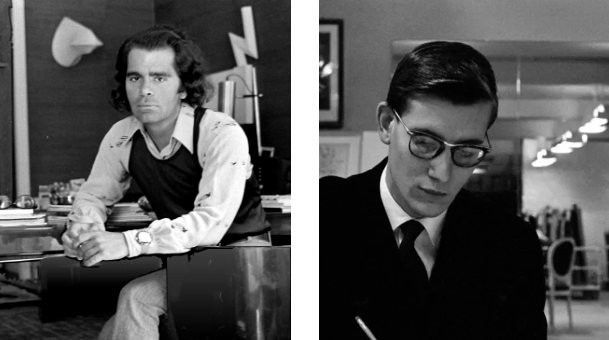
Paris, 1950s–60s: The City of Couture Kings
You see, Paris has crowned its designers like monarchs however it tends to not tolerate two kings at once. When Yves Saint Laurent and Karl Lagerfeld entered the fashion world, they weren’t just young talents.
They were prodigies.
They were threats.
They were the future.
And Paris knew immediately:
there wasn’t room for both.
Their rivalry didn’t begin with scandal. It began with brilliance — two young men rising at the same time, in the same city, with the same ambition and the same hunger for greatness.
This is where the feud starts.
1. Two Prodigies, One Spotlight
Yves Saint Laurent and Karl Lagerfeld were born only a year apart. They entered the couture world almost simultaneously and Paris reacted to them the way it reacts to all prodigies:
With fascination.
With fear.
With comparison.
YSL: The Poet of Couture
- shy
- delicate
- visionary
- emotionally sensitive
- a designer who saw fashion as art
Karl: The Intellectual Gladiator
- sharp
- strategic
- socially fearless
- competitive
- a designer who saw fashion as a battlefield
They were opposites — and that made them irresistible to the press.
Paris began asking the question that would define the next 30 years:
Who will inherit the future of fashion?
2. The Balmain–Dior Axis: Where the Rivalry Was Born
Both men entered couture through the same doors:
- YSL at Dior, becoming Christian Dior’s chosen successor
- Karl at Balmain, then Patou, building his reputation through discipline and technical mastery
They were young.
They were brilliant.
They were rising fast.
Fashion journalists wrote about:
- their youth
- their talent
- their contrasting personalities
- their competitive energy
- their parallel ascents
The feud wasn’t personal yet.
It was atmospheric — a tension in the air.
But it was about to become personal.
3. The Man Who Turned Rivalry Into War
Enter Jacques de Bascher — the man who became the emotional centre of the feud.
He was:
- beautiful
- aristocratic
- decadent
- magnetic
- a Parisian social phenomenon
Karl fell in love with him.
YSL became romantically involved with him.
This turned a professional rivalry into a deeply emotional conflict.
Karl felt betrayed.
YSL felt destabilized.
Paris felt electrified.
The feud was no longer about fashion. It was about ego, desire and heartbreak.
4. The Divergence: Two Paths, Two Empires
As the 1970s arrived, the rivalry evolved into something larger — a battle for the soul of modern fashion.
YSL’s Path: The Artist
YSL created:
- Le Smoking
- Safari chic
- Ballet Russes
- Opium
- the modern woman’s wardrobe
He became the designer who defined the 1970s — sensual, emotional, revolutionary.
Karl’s Path: The Strategist
Karl became:
- the revivalist
- the reinvention master
- the architect of modern branding
- the man who resurrected Chanel
- the designer who turned houses into global empires
He became the designer who defined the 1980s and 1990s — sharp, intellectual, un-stoppable.
Their feud became a battle of philosophies:
- art vs. strategy
- emotion vs. intellect
- vulnerability vs. armor
- muse‑driven vs. brand‑driven
Paris watched, fascinated.
5. Why This Feud Still Matters
YSL vs. Karl is not just a rivalry. It is the blueprint for modern fashion competition.
Their feud shaped:
- how designers build identity
- how houses cultivate myth
- how creative directors compete
- how fashion narratives are constructed
- how legacy is protected
Every modern feud — Givenchy vs. Balmain, Lanvin vs. Schiaparelli — resembles this one.
This is the feud that defined an era.
I’m Stacey Hobbs, thanks for reading Face by Stace! Until next time.
do you feel fabulous today?

 Face by Stace