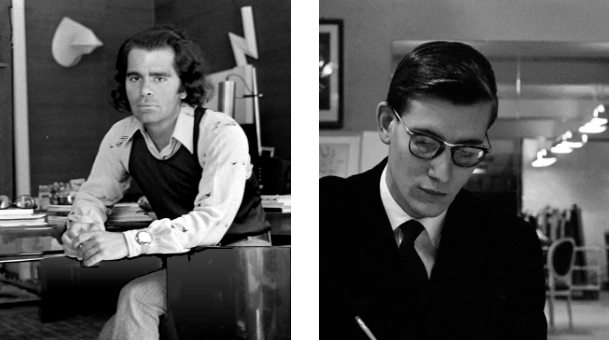
The War for the Soul of Paris
By the late 1960s, Paris was no longer simply the capital of couture — it was the arena where fashion’s future was being decided. Two men stood at the centre of that transformation: Yves Saint Laurent and Karl Lagerfeld. Their rivalry had already shifted from youthful comparison to emotional tension but now it evolved into something larger.
This was no longer a feud between two designers.
It was a battle for who would define modern fashion.
1. The 1970s: When YSL Became the Cultural Pulse
Yves Saint Laurent entered the 1970s with a kind of creative electricity that Paris had never seen before. His work didn’t just reflect culture — it createdculture.
He gave women:
- Le Smoking
- safari jackets
- transparent blouses
- peasant blouses
- the Ballets Russes collection
- the rise of ready‑to‑wear as a legitimate fashion force
YSL understood women’s liberation intuitively. His designs were sensual, intellectual and emotionally charged.
Paris felt it. The world felt it. Fashion changed because of him.
YSL became the designer who defined the 1970s — the decade of freedom and artistic rebellion.
2. The 1980s: When Karl Became the Architect of the Industry
Karl Lagerfeld entered the 1980s with a different kind of power — not cultural but structural. He didn’t just design fashion; he engineered fashion houses.
His greatest move was the resurrection of Chanel.
When Karl arrived at Chanel in 1983, the house was fading. It was elegant, respected but frozen in time. Karl didn’t preserve Chanel — he detonated it and rebuilt it.
He:
- modernized the tweed suit
- reimagined the camellia
- revived the double‑C logo
- turned accessories into global status symbols
- created runway theatrics
- transformed Chanel into a cultural empire
Karl didn’t define a decade — he defined the industry.
He became the designer who shaped the 1980s and 1990s — the decades of branding, globalization, and fashion-as-spectacle.
3. Two Philosophies, Two Empires
Their rivalry became a philosophical war.
YSL’s Philosophy: Fashion as Emotion
- beauty
- vulnerability
- sensuality
- artistic expression
- the woman as muse
YSL designed from the heart.
Karl’s Philosophy: Fashion as Strategy
- reinvention
- branding
- intellectual sharpness
- cultural commentary
- the house as a machine
Karl designed from the mind.
Paris was split between:
- YSL’s emotional revolution
- Karl’s structural revolution
Both were right.
Both were brilliant.
Both changed fashion forever.
4. The Press Turned the Feud Into Myth
Fashion journalists loved the contrast. They wrote about YSL’s fragility, Karl’s armor, YSL’s romanticism, Karl’s discipline, YSL’s muses and Karl’s empires.
The narrative became mythic:
YSL defined beauty. Karl defined power.
And Paris — always dramatic, always political — embraced the myth.
5. Who Defined Modern Fashion?
The answer is not simple, because modern fashion is not simple.
YSL defined the aesthetic of modern fashion.
He shaped the modern woman, the modern silhouette and the modern relationship between fashion and art.
Karl defined the structure of modern fashion.
He shaped the modern fashion house, the modern brand, the modern runway and the modern global fashion economy-
YSL defined how fashion looks.
Karl defined how fashion works.
Together, they built the industry we know today.
6. Why This Battle Still Echoes
Every modern designer — from Tom Ford to Hedi Slimane to Pierpaolo Piccioli — works inside the system YSL and Karl created.
Their feud shaped:
- creative director culture
- brand identity wars
- fashion house politics
- the rise of celebrity designers
- the tension between art and commerce
Paris still operates on their rules.
I’m Stacey Hobbs, thanks for reading Face by Stace! Until next time.
do you feel fabulous today?
 Face by Stace