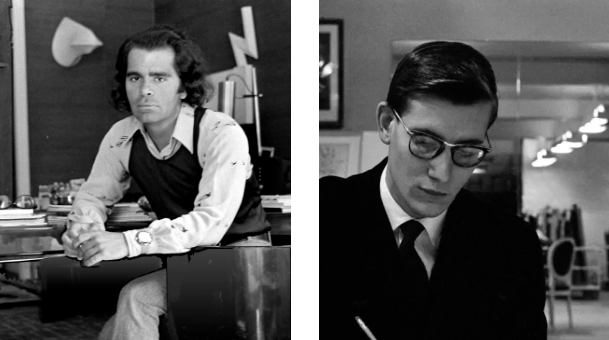
The Feud Becomes Flesh
By the time Yves Saint Laurent and Karl Lagerfeld reached the height of their rivalry in the 1950s, Paris had already chosen its narrative: two prodigies, two philosophies, two futures. But beneath the runway lights and couture politics, there was a quieter, more dangerous story un-folding — one that had nothing to do with fashion and everything to do with desire.
This is the chapter where the feud stops being professional.
This is where it becomes personal.
1. Jacques de Bascher: The Beautiful Catalyst
Jacques de Bascher was not a designer nor was he a muse in the traditional sense. He was a social phenomenon — aristocratic, decadent, magnetic and effortlessly destructive. He moved through Paris igniting everything he touched.
Karl fell in love with him.
YSL became romantically involved with him.
Jacques didn’t choose sides. He destabilized them both.
He was:
- the emotional centre of the feud
- the man who turned rivalry into heartbreak
- the figure who exposed the fragility beneath two titans
Paris whispered about it. The press hinted at it. The fashion world felt the tension.
This was no longer a battle for Paris. It was a battle for emotional survival.
2. YSL: The Fragile Genius
Yves Saint Laurent’s brilliance came from a place of vulnerability. He designed from emotion — raw, un-filtered, often painful. His relationship with Jacques intensified that fragility.
YSL struggled with:
- depression
- anxiety
- addiction
- the pressure of genius
- the weight of being Dior’s successor
- the emotional volatility of love
Jacques was both muse and wound.
YSL’s collections during this period — Ballets Russes, Opium, the transparent blouses — carried a kind of emotional electricity that felt almost dangerous. They were beautiful, yes, but they were also confessions.
Fashion historians often say:
YSL designed his heartbreak.
And in this era, it shows.
3. Karl: The Emotional Strategist
Karl Lagerfeld’s relationship with Jacques was different — quieter, more controlled, more intellectual. Karl did not collapse under emotion; he compartmentalized it.
But he was not immune.
Karl’s love for Jacques was:
- loyal
- protective
- deeply private
- quietly devastating
He did not compete with YSL for Jacques’s affection. He competed with himself — trying to maintain dignity while watching the man he loved drift toward his rival.
Karl’s response was not emotional collapse. It was work.
He poured himself into:
- Chloé
- Fendi
- photography
- the early seeds of what would become his Chanel revolution
Karl built empires to survive heartbreak.
4. The Feud Turns Psychological
The emotional triangle created a psychological war between the two designers.
YSL’s pain became art.
His collections grew more sensual, more vulnerable, more emotionally charged.
Karl’s pain became ambition.
His output became sharper, faster, more strategic, more prolific.
Their feud became:
- emotional vs. intellectual
- heartbreak vs. armor
- vulnerability vs. control
Paris watched two geniuses cope in opposite ways — and create some of the most influential fashion of the century in the process.
5. The Cost of Genius
The personal cost of this feud was immense.
For YSL:
- emotional instability
- addiction
- exhaustion
- the pressure of being a cultural icon
- the pain of loving someone who destabilized him
For Karl:
- emotional restraint
- loneliness
- the burden of un-requited love
- the need to build empires to protect himself
Their rivalry was not just professional competition. It was a coping mechanism.
Fashion historians often say:
YSL felt his genius. Karl weaponized his.
Both paid for it.
6. Jacques’s Death: The Final Wound
Jacques de Bascher died in 1989 at the age of 38. His death marked the end of the emotional feud — but not the professional one.
Karl was at his bedside.
YSL was devastated.
Paris mourned the end of an era.
Jacques’s death did not resolve the rivalry. It simply exposed how deeply human it had always been.
Fashion is not just silhouettes, branding, runway shows and couture politics.
It is ego, desire, heartbreak, vulnerability and the emotional cost of genius.
YSL and Karl were not just designers. They were men — brilliant, fragile, ambitious, wounded.
Their feud shaped fashion.
Their pain shaped their work.
Their love shaped their legacy.
I’m Stacey Hobbs, thanks for reading Face by Stace! Until next time.
do you feel fabulous today?
Depression — Historically Accurate
YSL struggled with severe depression throughout his life. This is documented in:
- his medical records from the late 1950s
- interviews with Pierre Bergé
- multiple biographies
- his own statements later in life
His depression intensified after:
- Dior’s death
- the pressure of becoming Dior’s successor
- his conscription into the Algerian War
- the emotional volatility of his relationship with Jacques de Bascher
- the pressures of running his own house
Anxiety — Historically Accurate
YSL suffered from debilitating anxiety especially around:
- runway shows
- press attention
- public appearances
- creative deadlines
- the expectations placed on him as Dior’s heir
He was known for:
- panic attacks
- emotional withdrawal
- long periods of isolation
- fear of failure
His anxiety was so severe that Bergé often had to manage his schedule and shield him from stressors.
Addiction — Historically Accurate
YSL struggled with addiction for decades.
This included:
- alcohol
- tranquilizers
- amphetamines
- cocaine (especially in the 1970s–1980s)
His addiction was widely known in the industry and openly discussed by Bergé after YSL’s death.
It affected:
- his health
- his relationships
- his work rhythm
- the emotional tone of his collections
This is one of the most documented aspects of his life.
The Pressure of Genius — Historically Accurate
YSL was considered a prodigy — a once‑in‑a‑generation talent. Paris treated him as such.
This created enormous pressure:
- to innovate
- to define culture
- to maintain brilliance
- to live up to his own myth
He often said he felt “crushed” by expectations.
His genius was both his gift and his burden.
The Weight of Being Dior’s Successor — Historically Accurate
This is one of the most important historical truths about YSL.
Christian Dior personally chose YSL as his successor at age 21.
When Dior died suddenly in 1957:
- YSL became head of the most important couture house in the world
- he was barely out of adolescence
- the press called him “the future of fashion”
- the industry placed impossible expectations on him
This pressure contributed directly to:
- his mental health struggles
- his anxiety
- his depression
- his emotional fragility
The Emotional Volatility of Love — Historically Accurate
YSL’s romantic life was deeply intertwined with his emotional stability.
His relationship with:
- Pierre Bergé (long‑term partner, protector, business partner)
- Jacques de Bascher (volatile, destabilizing, emotionally charged)
had profound effects on:
- his mental health
- his creativity
- his addictions
- the emotional tone of his collections
Jacques de Bascher’s involvement with both YSL and Karl Lagerfeld is one of the most documented emotional conflicts in fashion history.
YSL’s heartbreak during this period is well‑known and widely discussed by historians.
I’m Stacey Hobbs, thanks for reading! Until next time.
do you feel fabulous today?
 Face by Stace