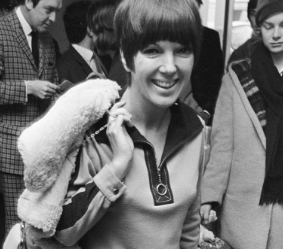
Few garments in fashion history have caused a cultural earthquake — but the mini skirt did. And at the centre of that shockwave stood Mary Quant, the British designer who didn’t just shorten skirts; she shortened the distance between youth culture and fashion itself.
The mini skirt wasn’t simply a trend. It was a declaration. A rebellion. A generational shift stitched into fabric.
This is the story of how Mary Quant turned a hemline into a movement.

1. London, 1960s: The Birthplace of Youthquake
The 1960s were not polite. They were loud, electric, rebellious — and London was the epicentre of that energy. Carnaby Street, King’s Road, and Chelsea became the playgrounds of a new generation who refused to dress like their mothers.
Mary Quant understood them instinctively. Quaint was styling for students, artists, dancers, musicians and girls who wanted freedom not formality.
Quant didn’t follow couture rules. She followed youth.
And youth wanted shorter skirts.
2. The Mini Skirt as Liberation
The mini skirt arrived at a moment when women were re-defining themselves. It symbolized:
- freedom
- bodily autonomy
- independence
- rebellion against conservative norms
- the rise of modern feminism
Quant famously said:
“A woman is as young as her knees.”
It was cheeky, provocative and perfectly aligned with the era.
3. The Quant Aesthetic: Playful, Modern, Unapologetic
Mary Quant’s designs were bold, geometric, youthful, affordable, accessible and fun.
She used bright colours, PVC, jersey, simple cuts, clean lines and mod silhouettes.
Her clothes didn’t require couture fittings or aristocratic budgets. They required confidence — and movement.
Quant democratized fashion by making it:
- wearable
- joyful
- modern
- fast
She was the mother of fast fashion, long before the term existed.
4. The Mini Skirt vs. Couture: A Cultural Clash
Paris couture houses were horrified.
To them, the mini skirt was:
- vulgar
- unserious
- childish
- undignified
But Quant wasn’t trying to impress couture. She was trying to liberate women.
The clash between Parisian tradition and London youth culture, which created one of the most important fashion debates of the 20th century.
And youth won.
5. Twiggy, Mod Girls, and the Global Spread
The mini skirt exploded globally thanks to:
- Twiggy
- Jean Shrimpton
- British pop culture
- photography
- magazines
- television
Suddenly:
- New York wanted it
- Paris adopted it
- Milan embraced it
- Tokyo idolized it
The mini skirt became the uniform of the 1960s — a symbol of modernity, rebellion and optimism.
6. The Social Shockwave
The mini skirt changed:
- how women walked
- how women sat
- how women danced
- how women moved through public space
It forced society to confront:
- female autonomy
- female sexuality
- female visibility
It sparked debates in:
- parliament
- churches
- newspapers
- universities
It was a garment that demanded cultural conversation.
7. Why Mary Quant Still Matters
Quant didn’t just shorten skirts. She shortened the distance between:
- fashion and youth
- fashion and freedom
- fashion and regular women
Her legacy lives in:
- streetwear
- fast fashion
- high‑low dressing
- modern silhouettes
- the democratization of style
Every time a woman chooses comfort, movement or rebellion in her clothing — she is echoing Mary Quant.
8. The Mini Skirt Today
The mini skirt remains:
- iconic
- controversial
- empowering
- cyclical
- modern
It appears in:
- runway revivals
- Y2K nostalgia
- contemporary street style
- feminist discourse
- archival exhibitions
It is still a symbol of youth, freedom and cultural disruption.
Mary Quant’s shockwave never ended. It simply evolved.
I’m Stacey Hobbs, thanks for reading Face by Stace! Until next time.
do you feel fabulous today?
 Face by Stace