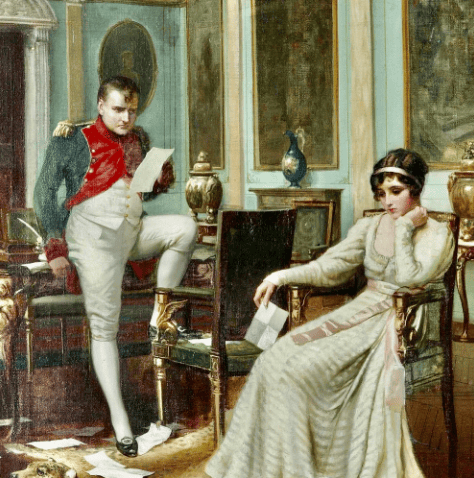
When Napoleon crowned himself Emperor in 1804, France entered a new age of spectacle — and at the centre of this imperial world stood Joséphine de Beauharnais, the woman who transformed French beauty from post‑revolutionary restraint into a revived symbol of luxury, sensuality and political power. Joséphine was not merely a fashionable figure; she was the vibe of the architect of the Empire. Her influence shaped everything from perfume culture to hair design, turning Paris once again into the world’s beauty capital.
Joséphine’s beauty philosophy was rooted in softness, elegance, and emotional allure. She favoured delicate curls arranged around the face, often adorned with pearls, gold combs or fine ribbons. Her hairstyles were inspired by classical antiquity but elevated with imperial ornamentation — a blend of Greek purity and French opulence. Her gowns, cut in the high‑waisted Empire silhouette, floated around her like mist, made of gauzy muslins and silks that emphasized movement and femininity. Joséphine understood that beauty was not static; it was theatrical, symbolic, and deeply tied to the identity of the new French Empire.
Perfume became her signature power. Joséphine adored fragrance with an intensity that shaped the entire era. She famously filled her residence at Malmaison with roses, jasmine, and orange blossoms, creating an environment saturated with scent. Her personal perfume collection was vast and her love of musk and floral waters helped revive the French perfumery industry after its near collapse during the Revolution. Napoleon himself was obsessed with cologne, reportedly using it in lavish quantities, but it was Joséphine who made fragrance a cultural force again — sensual, feminine and un-mistakably French.
Cosmetics also returned under her influence. Rouge, once politically dangerous, re-appeared in soft, natural tones. Skin was kept pale but luminous, achieved through light powders rather than the heavy white lead of the ancient régime. Jewelry became essential: tiaras, cameos and delicate imperial motifs that signaled both femininity and status. Joséphine’s beauty was not about excess; it was about refined luxury, a carefully curated aesthetic that balanced softness with imperial authority.
Under Joséphine, beauty became a diplomatic language. Her presence at court set the tone for fashion across Europe, and her style was copied in royal courts from Vienna to St. Petersburg. She embodied the idea that beauty could stabilize a nation emerging from chaos — that elegance could be a form of political reassurance. In her hands, French beauty re-gained its identity: romantic, luxurious and quietly powerful.
This chapter marks the height of Napoleonic glamour, the moment when French beauty re-claimed its throne through Joséphine’s influence. It is the era where perfume, fashion and femininity intertwined to create the un-mistakable vibe of the Empire, a look that remains in modern French beauty today.
I’m Stacey Hobbs, thanks for reading Face by Stace! Until next time.
do you feel fabulous today?
 Face by Stace