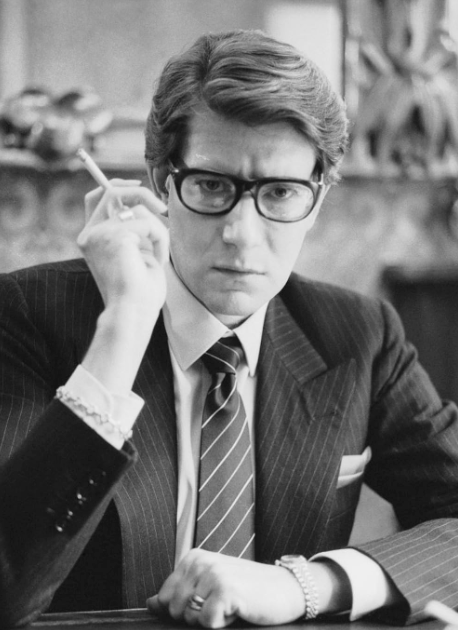
On January 29, 1971, little did Yves Saint Laurent knew, he would be walking into the history books — and at the exact same time, straight into a firestorm. His Spring/Summer haute couture show, later known simply as “The Scandal Collection,” was unlike anything Paris had ever seen. It wasn’t elegant. It wasn’t polite. It wasn’t nostalgic in the way couture preferred. It was provocative, political, and deliberately confrontational. And this collection of YSL’s collection changed the structure of fashion forever.
The Inspiration:
1940s Wartime Paris, But Not the Romantic Version
YSL refused the soft-focus nostalgia that other designers clung to. Instead, he turned toward the Paris no one wanted to remember, ever. A time when the occupied city of the 1940s, with its black‑market glamour, nightclub girls, and women who survived by their wits, their bodies, or their style. His references weren’t Dior’s New Look but the raw, improvised elegance of wartime: platform shoes worn thin on dance floors, square shoulders borrowed from men’s jackets, tight skirts that moved like defiance, fox‑fur stoles bought in the shadows, and exaggerated makeup applied like armor. What he sent down the runway wasn’t a revival of the past but a reckoning with it — a portrait of survival, not nostalgia.
The Clothes That Caused the Outrage
The collection marched out in boxy, padded shoulders, knee‑length skirts that felt almost defiantly dowdy, bright colours bordering on vulgar, fox‑fur stoles, platform shoes, tight belted waists, and retro curls paired with red lips. It looked less like couture and more like the wardrobe of a nightclub hostess in 1942 — a woman navigating occupied Paris with charm, grit, and whatever glamour she could assemble. It was a jarring, provocative tableau that shattered the refined expectations of the couture salon. Critics were horrified, clients un-settled, and the press un-leashed a fury that only confirmed what YSL already knew: he had struck a nerve.
The Reaction: “A Fashion Faux Pas”
The French press erupted. They called the collection “ugly,” “vulgar,” “an insult to couture,” going so far as to call the collection “a bad joke.” Le Figaro delivered the final blow, dismissing it as “une faute de goût” —meaning, a mistake in taste. Clients cancelled their orders. Some walked out mid‑show. Others swore they would never return. But YSL didn’t flinch. He stood firm as the room recoiled, knowing exactly what he had done: he had forced Paris to confront a past it preferred to forget, and in doing so, he had pushed couture into the future.
What Critics Missed:
YSL Was Predicting the Future
The Scandal Collection wasn’t a backward glance — it was a forecast. Within just a few years, the fashion world embraced everything Paris had mocked: 1940s shoulders, platform shoes, retro glamour, bold makeup, and vintage silhouettes. YSL had seen the 1970s before the 1970s understood themselves. What the French press dismissed as “vulgar,” the world soon recognized as modern.
Why It Was Classified as a Scandal —
And Why It Matters
The outrage wasn’t really about the clothes — it was more about what they forced Paris to confront. YSL dragged the city back into the trauma of the Occupation, the women who survived by any means, and the uncomfortable truth that glamour can rise from darkness. He shattered the un-spoken rule that couture must be tasteful, polite, and apolitical. In 1971, he showed that fashion could be dangerous and that was, perhaps, the real scandal.
The Legacy: A Turning Point in Fashion History
Today, the 1971 collection is recognized as visionary — influential, ahead of its time, and a blueprint for every retro revival that followed. What Paris once mocked is now preserved in museums. YSL didn’t just provoke the couture establishment; he dragged it into the future. The scandal wasn’t a misstep. It was a masterpiece.
Paris wasn’t prepared or ready for what Yves Saint Laurent had presented with his 1971 Scandal Collection, but the world was, despite it causing the real scandal that walked the halls, the seats, the runways that Paris had not ever encountered before until YSL’s 1971 Scandal Collection. Fashion was never going to be the same again. Fashion changed forever.
I’m Stacey Hobbs, thanks for reading Face by Stace! Until next time.
do you feel fabulous today?
 Face by Stace