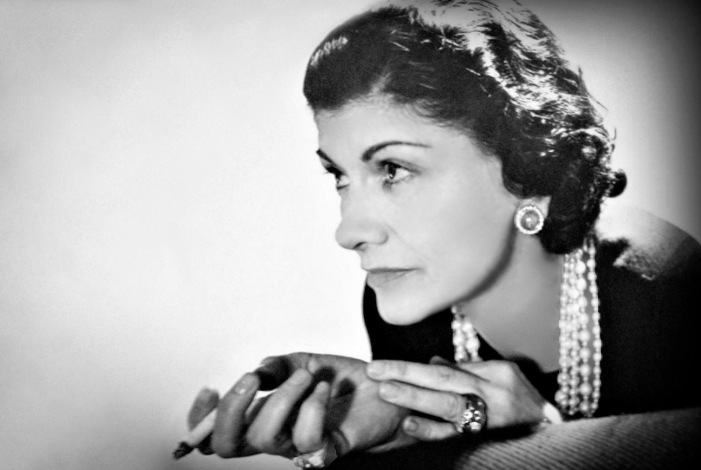
Coco Chanel designed her clothes the way she lived her life: instinctively, physically, and without pretense. While other couturiers sketched elaborate designs on paper, Chanel rejected the idea that fashion could be conceived in two dimensions. She didn’t draw. She didn’t storyboard. She didn’t begin with a silhouette imagined from afar. Chanel designed with her hands, directly on the body, shaping fabric in real time until it matched the clarity she carried in her mind.
Her process was tactile, intimate, and almost improvisational. Chanel began with fabric, not a sketch. She draped it over a mannequin or a fit model, pinning and un-pinning, cutting and re-shaping, adjusting the fall of a sleeve or the curve of a neckline until the garment felt inevitable. She trusted her eye more than any pencil. She trusted movement more than theory. And she trusted the body — its needs, its rhythms, its natural proportions — far more than the decorative traditions of couture.
This approach produced clothes that looked simple, but were anything but simplistic. Chanel’s simplicity was engineered through touch. She refined garments through countless micro‑adjustments: a softened shoulder, a shortened hem, a seam moved half an inch to restore balance. Her fashion house often watched her work in silence, waiting for her to declare a garment “right,” knowing that her approval came not from aesthetic flourish, but instead from the garment’s ability to move with ease. Chanel’s clothes were not built to impress from a distance. They were built to live in.
Designing directly on the body also shaped her philosophy. Chanel believed fashion should liberate women, not restrain them. She refused corsetry, padding, and the rigid structures that dominated early twentieth‑century couture. Instead, she created clothes that followed the body’s natural lines — jersey dresses that skimmed rather than clung; cardigans that moved rather than stiffened; suits that allowed women to walk, work, and breathe. Her garments were born from life, not fantasy. They were designed for women who needed clothing that could keep pace with them.
This method set her apart from her contemporaries. While designers like Poiret and later Dior built theatrical silhouettes from sketches and structured underpinnings, Chanel’s work emerged from instinct and practicality. She didn’t impose shape; she discovered it. She didn’t sculpt women into ideals; she revealed their ease. Her clothes were modern because her process was modern — grounded in reality, movement, and the tactile intelligence of her own hands.
Chanel’s refusal to draw was not a limitation. It was her advantage. By designing directly on the body, she created garments that felt lived‑in from the moment they were made. Her suits, dresses, and knits carry that quality even today: an effortless clarity, a sense of inevitability, a quiet confidence that comes from being shaped by touch rather than theory.
Chanel didn’t sketch fashion. She felt it — and that is why her work still feels alive.
I’m Stacey Hobbs, thanks for reading! Until next time.
do you feel fabulous today?
 Face by Stace