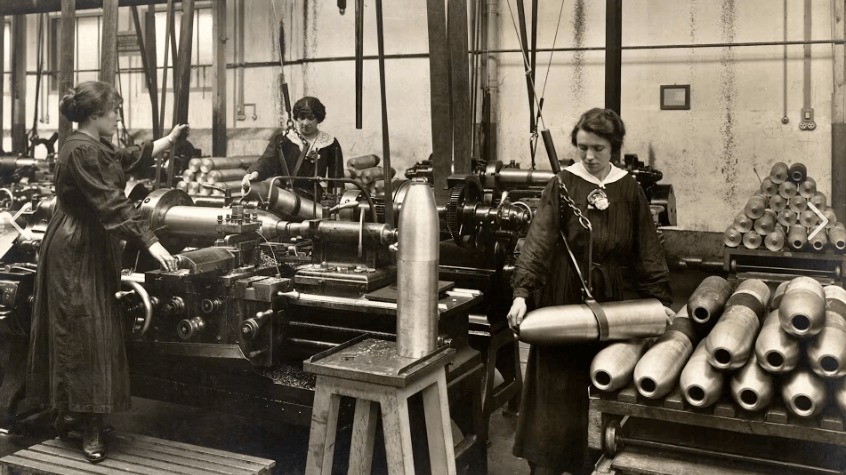
World War I didn’t just alter borders and politics, it transformed daily life, gender roles, industry, and consumer culture. And beauty is always the first place where social change becomes visible. The war created a new kind of woman, a new kind of economy, and a new kind of beauty standard.


1. Women Entered the Workforce, and Beauty Followed
Before WWI, most women in Canada, America, and Europe lived within domestic spheres. The war changed that overnight.
With men overseas, women stepped into:
- factories
- munitions plants
- transportation
- agriculture
- clerical work
This shift had direct beauty consequences. Work was physical, fast‑paced, and often dangerous, which meant traditional beauty routines — elaborate hair, heavy skirts, restrictive corsetry — were no longer practical. Women needed styles that allowed movement, safety, and efficiency. Hair was pinned up or cut shorter. Clothing became simpler, lighter, and more functional. Makeup, once considered improper, began to appear discreetly as women sought small ways to maintain femininity in industrial environments.
The war didn’t just change where women worked. It changed how they presented themselves, how they saw themselves, and how society saw them. Beauty became less ornamental and more adaptive — a quiet reflection of women’s expanding roles outside the home.
Shorter Hair
Long hair was impractical around machinery. Women began pinning their hair tightly, cutting it shorter, and adopting proto‑bob styles that kept strands away from gears, heat, and hazardous equipment. Factories demanded efficiency and safety, and beauty adapted accordingly. What had once been a symbol of femininity — long, heavy hair arranged in elaborate styles — suddenly became a liability. Women needed hair that allowed them to work quickly, safely, and without constant maintenance.
This was the seed of the 1920s bob — born from necessity, not rebellion. Wartime practicality introduced women to the freedom of shorter hair, and once they experienced its convenience, many never returned to pre‑war styles. By the time the 1920s arrived, the bob was no longer simply a functional cut; it had evolved into a cultural statement. But its origins were rooted in the factories of WWI, where beauty quietly re-shaped itself to meet the demands of a new world.
Minimal Makeup
Factory rules discouraged heavy cosmetics. Women wore light powder, subtle rouge, a touch of petroleum jelly on their lashes, and kept grooming simple and utilitarian. Beauty had to withstand heat, dust, long shifts, and strict regulations. Anything too scented, too shiny, or too elaborate was considered impractical — and in some cases, unsafe. The goal was to look tidy, not decorative, and to maintain a sense of personal dignity within demanding industrial environments.
This was beauty stripped down to its essentials. It became functional, shaped by necessity rather than fashion. These pared‑back routines transformed cultural expectations, where women learned to value practicality, efficiency, and subtlety in their appearance. By the time the post‑war years arrived, this new relationship with beauty — streamlined, modern, and less bound by Victorian ideals — had already begun to influence the aesthetics of the 1920s and beyond.
2. Scarcity Changed What Women Could Buy
Wartime shortages meant fats, oils, alcohol, metals, glass, and key industrial chemicals were re-directed toward military production. These materials were essential for cosmetics — everything from cold creams and lipsticks to powders, soaps, and perfumes relied on ingredients suddenly classified as wartime necessities. Factories that once produced beauty goods shifted to manufacturing munitions, medical supplies, and machinery, leaving women with fewer products and far simpler formulas.
With beauty houses limited by rationing, women adapted. They stretched what they had, re-purposed household items, and embraced a pared‑down routine shaped by scarcity rather than fashion. This period of minimalism didn’t diminish women’s interest in beauty; instead, it transformed it. Wartime shortages pushed beauty culture toward practicality, resourcefulness, and innovation, with changes that would influence post‑war cosmetics and set the stage for the streamlined, modern aesthetics of the 1920s.
Cold Cream + Soap
Wartime shortages meant that key ingredients used in cosmetics — fats, oils, alcohol, metals, glass, and industrial chemicals — were diverted to military production. Beauty houses struggled to source even the most basic materials, and many factories that once produced creams, powders, and perfumes were re-purposed for munitions or medical supplies. With commercial products limited or un-available, women turned to simple, practical alternatives that could be made at home or purchased cheaply.
Women relied on homemade cold creams, basic soaps, and natural oils to maintain their routines. These improvised products were far less luxurious than pre‑war cosmetics, but they offered a sense of normalcy during a period defined by scarcity. Beauty became an exercise in resourcefulness — a pared‑down, utilitarian practice shaped by necessity rather than fashion. This wartime minimalism influenced post‑war aesthetics, laying the groundwork for the streamlined, modern beauty culture that emerged in the 1920s.
Perfume
Alcohol was rationed for medical and military purposes, which meant perfume production slowed dramatically. Many fragrance houses either halted operations or produced only minimal quantities for elite clients. For most women, perfume became a luxury they could no longer access. Instead, they turned to simple floral waters, homemade distillations, or went without scent entirely. Beauty during the war shifted from indulgence to practicality, and fragrance — once a daily ritual — became another reminder of the sacrifices woven into wartime life.
Packaging
Metal shortages meant fewer compacts, fewer lipstick tubes, and a widespread shift toward cardboard and paper packaging. Beauty brands had to re-think how products were stored, sold, and carried, often re-placing metal cases with lightweight, disposable alternatives. The ornate vanity items women once kept on dressing tables — engraved compacts, decorative lipstick holders, mirrored cases — became rare luxuries. In their place came modest, pared‑down designs that reflected the austerity of wartime life.
Beauty became modest, resourceful, and stripped of excess. Women adapted to packaging that was practical rather than glamorous, and this simplicity subtly re-shaped the aesthetics of everyday beauty. The war didn’t eliminate women’s interest in cosmetics; it transformed it, pushing beauty culture toward functionality and frugality — changes that would echo into the post‑war years and influence the streamlined modernity of the 1920s.
3. Fashion Shifted Toward Practicality
Hemlines Rose
Hemlines rose — not for style, but for mobility. Shorter skirts made factory work easier, allowing women to move quickly, climb steps, operate machinery, and navigate crowded industrial floors without the weight and drag of heavy fabric. The long, layered skirts of the pre‑war years were simply incompatible with the demands of wartime labour. As women adapted their clothing to the realities of work, practicality altered fashion. What began as a functional adjustment would later influence post‑war silhouettes, helping usher in the streamlined, modern styles of the 1920s.
Corsets Declined
Steel was needed for ships and weapons, and corset production halted almost overnight. Without the rigid metal supports that had defined women’s undergarments for decades, the silhouette softened. Women adopted simple brassieres, lighter undergarments, and more natural lines that allowed them to work, move, and breathe with far greater ease. What began as a wartime necessity quietly shifted the foundations of women’s fashion.
This was the beginning of modern lingerie. The rigid, constricting shapes of the Victorian and Edwardian eras gave way to comfort, practicality, and a new understanding of the female form. Once women experienced the freedom of lighter undergarments, they didn’t return to the old structures — and the post‑war years would build on this transformation, ushering in the streamlined silhouettes of the 1920s.
Uniform Influence
Military aesthetics entered civilian fashion: structured coats, trench coats, khaki tones, and practical boots became part of everyday wardrobes. These pieces were durable, weather‑resistant, and designed for movement — qualities that aligned perfectly with the demands of wartime life. As women navigated factories, transport work, and volunteer roles, clothing borrowed from military design offered both protection and efficiency.
The war introduced the idea that clothing could be functional and stylish. Utility no longer meant unattractive; instead, it became a new form of modernity. This blending of practicality and aesthetics laid the groundwork for post‑war fashion, where streamlined silhouettes, tailored outerwear, and neutral palettes would continue to shape women’s wardrobes well into the 1920s.
4. The Psychological Impact: Beauty as Morale
Governments encouraged women to maintain grooming as a symbol of national morale. Even small acts of personal care — tidy hair, clean nails, a touch of powder — were framed as contributions to stability and spirit on the home front. Beauty became a re-assurance that life, dignity, and order persisted despite the uncertainty of war.
In Canada and America, posters urged women to:
- stay neat
- stay presentable
- maintain dignity
- “do their part” by keeping spirits high
This is why, even in scarcity, women found ways to:
- tint cheeks with beet juice
- darken lashes with soot or petroleum jelly
- style hair simply, but neatly
Beauty was an emotional resilience.
5. The Birth of the Modern Beauty Industry
WWI accelerated industrialization. Factories that once produced wartime goods later produced powders, lipsticks, mascaras, creams, and perfumes. The machinery, assembly‑line methods, and chemical processes developed for military manufacturing were re-purposed for civilian industries — beauty included. What had once been a small, fragmented sector suddenly had the infrastructure to scale.
Companies like Max Factor, Elizabeth Arden, Coty, and Maybelline expanded rapidly after the war, using wartime manufacturing techniques to create standardized products at mass volume. These brands embraced industrial efficiency, modern packaging, and scientific formulations, positioning beauty as part of a new, modern lifestyle. The post‑war boom didn’t just revive cosmetics; it transformed them into a fully fledged industry — organized, branded, and ready to define the aesthetics of the 1920s.
This is why the 1920s saw an explosion of:
- commercial cosmetics
- standardized packaging
- mass advertising
- department store beauty counters
WWI laid the industrial foundation for the beauty boom of the 1920s.
6. Changing Gender Roles = Changing Beauty Standards
Women proved they could work, manage households, and contribute to national efforts. This changed how society viewed femininity. Strength, competence, and resilience became part of the female image, expanding the definition of what women could be. The war demonstrated that femininity was not fragile or ornamental — it was capable, adaptable, and essential to national stability. As women stepped into roles once reserved for men, the cultural boundaries around gender shifted, laying the groundwork for a more modern understanding of womanhood.
Before WWI
Before WWI, femininity was closely tied to domesticity, delicacy, and modesty. Women were expected to embody gentleness and restraint, with beauty framed as something ornamental rather than functional. Their roles were largely confined to the home, and cultural ideals emphasized softness, passivity, and a carefully maintained appearance that reflected Victorian and Edwardian values. This narrow definition of femininity shaped everything from clothing to grooming — until the war disrupted it.
After WWI
After WWI, femininity came to signify independence, capability, and modernity. Women had stepped into public life — working, organizing, managing households, and contributing directly to national stability — and society could no longer confine femininity to delicacy or domesticity. The female image expanded to include strength, competence, and self‑direction. Beauty and fashion followed suit, embracing streamlined silhouettes, practical routines, and a modern aesthetic that reflected women’s new roles and freedoms.
The House of Lanvin adapted quickly to the post‑war world, embracing the new emphasis on practicality and modern femininity. Jeanne Lanvin’s designs — soft, fluid, and quietly luxurious — aligned perfectly with women’s shifting roles, offering clothing that balanced elegance with ease of movement. Her atelier became one of the first major fashion houses to translate wartime changes into a refined, modern aesthetic, helping shape the look of the emerging “new woman.”
Coco Chanel emerged from the post‑war period with a radically modern vision of femininity. Her designs rejected pre‑war ornamentation in favour of simplicity, comfort, and freedom of movement — ideals shaped directly by wartime practicality. Jersey, once considered a humble fabric, became a symbol of modern elegance under her hand. Chanel’s silhouettes were relaxed, streamlined, and deliberately un-restrictive, reflecting the new reality of women who worked, moved, and lived with greater independence. In redefining luxury as something effortless rather than elaborate, Chanel helped crystallize the aesthetic of the modern woman and set the tone for the decade that followed.
Beauty reflected this shift:
- simpler hairstyles
- practical clothing
- subtle but intentional make-up
- a move away from Victorian excess
This emphasis on composure created a bridge to the post‑war years. When peace returned, women carried these habits with them: streamlined routines, lighter cosmetics, shorter hair, practical clothing, and a new understanding of beauty as something modern, efficient, and self‑directed. These wartime shifts didn’t disappear; they evolved, setting the stage for the bold, liberated aesthetics of the Flapper era.
I’m Stacey Hobbs, thanks for reading! Until next time.
do you feel fabulous today?
 Face by Stace