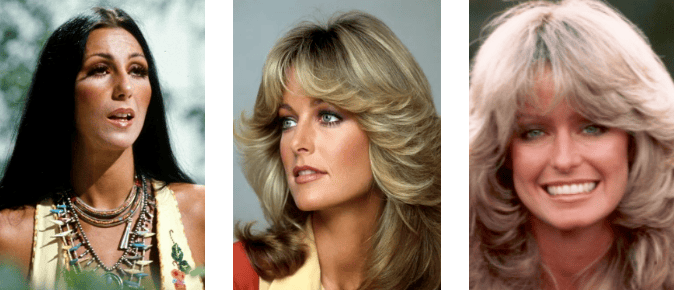
The 1970s were a decade defined by movement, bodies in motion, hair in motion, a culture in motion. Beauty shifted away from the sculpted, set styles of the 1960s and toward something freer, more athletic, more sun‑lit. Hair became a symbol of lifestyle, identity, and attitude. And at the centre of this transformation were three women who became cultural landmarks: Farrah Fawcett, Cher and Bo Derek. Each represented a different facet of 1970s femininity and together they shaped the decade’s most enduring beauty ideals.

Farrah Fawcett’s hair was not simply a style — it was a phenomenon. Her aerodynamic feathered layers captured the spirit of California glamour: bright, athletic, effortless and alive. The cut was engineered for movement, lifting away from the face in soft wings that seemed to flutter with every laugh, every run, every moment of joy. Farrah’s hair looked like it was always mid‑motion, mid‑life, mid‑sunbeam. It was the first hairstyle that felt kinetic, a visual embodiment of the decade’s obsession with outdoor living, jogging, surfing and roller skating. The blow‑dry became a cultural phenomenon because of her. Women across North America flocked to salons asking for “the Farrah,” and stylists spent years perfecting the round‑brush technique that created her signature bounce. Farrah’s hair wasn’t just glamorous — it was aspirational, a symbol of health, vitality and California freedom.
Cher, by contrast, represented the decade’s minimalist glamour. Her long, straight, centre‑parted hair was a sheet of glossy darkness, dramatic in its simplicity and powerful in its restraint. Where Farrah’s hair moved, Cher’s hair flowed. It was sleek, controlled and impossibly shiny — a 1970s re-interpretation of 1930s screen‑sirens, updated for a modern woman who commanded the stage with presence rather than ornamentation. Cher’s hair became iconic because it refused excess. It was a statement of confidence: no curls, no layers, no volume, just pure, un-interrupted length. Her silhouette influenced fashion photography, album covers and runway styling throughout the decade. Cher’s look was proof that simplicity could be just as commanding as glamour.
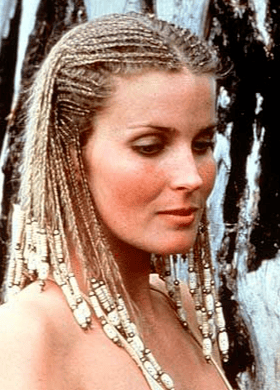
Bo Derek entered the cultural conversation at the end of the decade but her impact was immediate and un-forgettable. Her cornrow braids in the film 10 (1979) became one of the most recognizable beauty moments of the era. Sculptural, beach‑ready and sun‑lit, the braids fused California beach culture with a controversial but influential braided vibe. Bo’s look was athletic and sensual, a departure from both Farrah’s feathered softness and Cher’s sleek minimalism. Her braids became synonymous with the late‑1970s obsession with beach bodies, tanning and outdoor life. The image of Bo running along the shoreline — braids swinging, skin glowing — became a symbol of the decade’s fixation on health, fitness and natural sensuality.
Together, Farrah, Cher and Bo defined the spectrum of 1970s hair. Farrah embodied movement, Cher embodied minimalism and Bo embodied athletic sensuality. Their looks shaped not only beauty trends but the cultural imagination of the decade. The 1970s were a time when hair expressed lifestyle, identity and freedom — and these three women became its most enduring icons.

I’m Stacey Hobbs, thanks for reading Face by Stace! Until next time.
do you feel fabulous today?
 Face by Stace