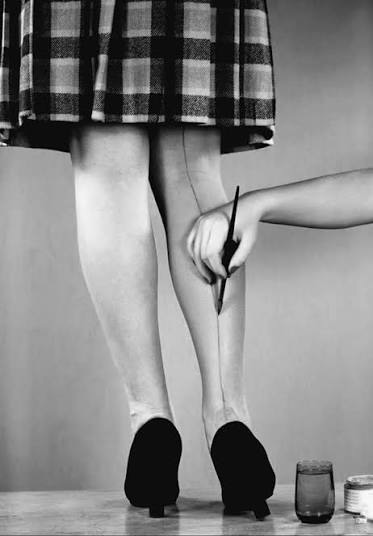
Before we begin, I’ve got a question for you. Have you tried painting the legs to appear like nylon stockings? Including drawing the line at the back of the legs? And I’m not referring to a spray bottle like they have today. It isn’t as easy as it looks I can tell you that much. One mistake and you’ve got to start from scratch.
During World War II nylon stockings largely disappeared from civilian life, because nylon production was re-directed to military uses (parachutes, ropes, tire reinforcement), prompting rationing, black markets, creative leg-make-up solutions came into play and intense post-war demand that sparked the so‑called, the infamous “nylon riots.”

1936-1937)/www.smithsonianmag.com
Nylon was invented in the mid‑1930s and introduced to the public as a revolutionary hosiery fibre as early as 1939 and later than 1940; its stretch, durability, and “no‑run” promise made stockings a fashion must‑have almost instantaneously.
During WWII many women simulated stockings by applying a thin, sheer “leg make-up” (often called liquid stockings) and drawing a seam line; recipes ranged from commercial leg make-up to home mixes like tea or gravy browning and the look was widely taught in war-time beauty guides and films. Tea? Gravy browning? Did these ingredients actually hold up as a substitute for stockings?
Wartime conversion and shortages
Nylon was diverted to war production and civilian hosiery largely halted by early 1942. This shift is the central cause of wartime shortages and later post-war demand. The key date of wartime conversion after Pearl Harbor.
The War Production Board and related agencies managed raw materials; silk imports from Japan had already been curtailed before full nylon conversion.
Nylon’s military uses made it strategically important, so civilian hosiery production was suspended.
When limited civilian shipments resumed in 1945–1946, mass crowds and “nylon riots” erupted in multiple cities as women queued for scarce pairs. Examples in the press include long lines, store scuffles, and police crowd control. These are widely reported in local papers of late 1945.

Women improvised with leg make‑up (“paint‑on” stockings) and commercial products such as “Stocking Stick.” Advertisements and how‑to columns from the era promoted these alternatives.
The creative adaption:
Leg Make-up


Women had to resort to creativity, since leaving the home without nylon stockings was un-heard of. In other words, it was societal un-acceptable, un-civilized to step out in bare legs. What would the people say? This would lead to war-time shortages sparked a massive cosmetic boom.
Women on the home front used “liquid stockings,” which are cosmetic preparations spread thinly over the legs to mimic silk hosiery and often finished the look by drawing a dark seam up the back of the leg with eyeliner pencil to imitate seamed stockings. This practice became common because nylon and silk were diverted to the war effort, creating widespread shortages. There was a war going on, don’t you know?
Many period sources and modern retrospectives document a range of approaches: commercial leg make-up bars or creams, thin liquid foundations and improvised household mixtures (tea, shoe polish dilutions or gravy browning in Britain) were reported. These methods varied in smell, longevity, and realism.
These home-made recipes were curated for women who couldn’t afford leg make-up or could find leg make-up, what was one to do? Resort to creative alternatives.
A common recipe from back in the day in the 1940s, kitchen staples like cocoa powder, instant coffee or tea, and liquid gravy browning (e.g., Kitchen Bouquet) were mixed with creams or water and smoothed onto the skin.
The hazard that may follow, while it offered a flawless artificial tan, this do-it-yourself method had drawbacks. Primarily with the savoury smell, the threat of running in the rain, oh, and let’s not forget, the risk of being chased by hungry neighbourhood pets. Oh, wait, there are those dogs coming, again.
Perfecting the Illusion
To ensure the painted legs looked exactly like real stockings, a few extra steps were taken.
The Back Seam
The defining feature of 1940s stockings was the seam running up the back of the leg. Women used black or brown eyebrow pencils to draw a perfectly straight line.
The Heel Details
Many women would also shade the ankle and heel areas with makeup to mimic the reinforced heels of traditional silk or nylon hose.
Historical recipes give the most period-accurate finish but often used non-cosmetic ingredients that could stain clothing or irritate skin.
- Leg makeup and “painted seams” to simulate stockings.
- Wearing rayon or cotton hose when available, though these were less durable and less flattering.
- Conserving and collecting damaged stockings for recycling into military supplies; collection drives were organized.
- A thriving black market emerged; used or smuggled nylons fetched many times the retail price.
Commercial Brands
Drugstores sold specialized leg foundations and stocking sticks by brands like Leg Silque, Toots, and LA Jack.
Bare Leg Bars
Department stores even set up “Bare Leg Bars” where women could have the leg makeup professionally applied and the seams perfectly drawn.
These adaptations also influenced fashion (greater acceptance of slacks and different skirt lengths) and everyday grooming practices.

Post-war demand and the Nylon Riots
When small shipments of nylons returned after Japan’s surrender, pent‑up demand exploded. Massive crowds, fights and broken windows—referred to as “nylon riots”— which occurred in multiple U.S. cities between late 1945 and early 1946 as women rushed stores for limited pairs. DuPont eventually scaled production to meet demand, but the immediate aftermath was chaotic.


Today, modern iterations of this vintage WWII staple (such as Sally Hansen Airbrush Legs or Dermablend Leg and Body Make-up) are still utilized to cover imperfections and achieve a flawless, airbrushed look.
I’m Stacey Hobbs, thanks for reading. Until next time!
do you feel fabulous today?
 Face by Stace