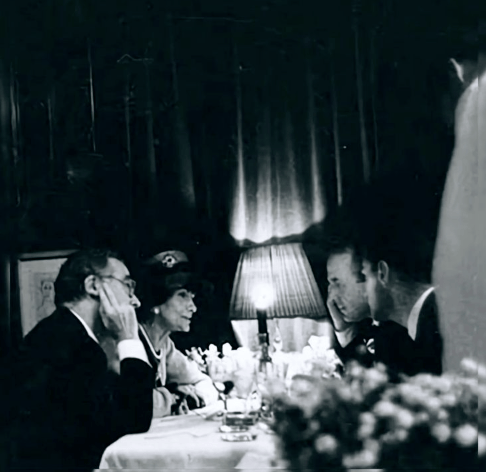
If Christian Dior and Balenciaga were respectful opposites, then Chanel and Balenciaga were something far more elemental, two poles of couture, two visions that differed, but their opposite definitions of their visions defined what fashion could be.
After two decades of a friendship, Chanel did what Chanel does, she went to the press and spilled Balenciaga’s secrets, one of which was to out him as gay. Balenciaga had his assistant pack up all of Chanel’s gifts that she had given to him in their two decade friendship to send to Chanel, as his response to her. Balenciaga felt betrayed, disappointed and was in utter sadness, despair one may even go so far as to say. That is the closet either of them had gotten to feud publicly.
Their work on the other hand, stood in such stark contrast that their differences became part of fashion’s mythology. To understand Balenciaga’s genius, and Chanel’s defiance of it, you have to see how radically their visions diverged.
Chanel: The Liberator of Women
Chanel believed fashion should free the body. Her silhouettes were built on ease, movement, and a kind of elegant nonchalance. She rejected structure, padding, corsetry, and anything that felt fussy or ornamental. Her clothes were meant to be lived in — jersey knits, simple lines, clean tailoring, and a philosophy rooted in comfort as luxury.
To Chanel, anything that restricted a woman was an enemy. She once dismissed postwar couture excess as “ridiculous,” and she famously criticized Dior’s New Look for putting women “back in cages.” Her rebellion was personal, ideological, and deeply modern.
Balenciaga: The Master of Couture
Balenciaga, by contrast, believed in discipline, structure, and the sculptural possibilities of fabric. He didn’t liberate the body, instead he re-imagined it. His silhouettes were architectural:
- the barrel line
- the balloon jacket
- the cocoon coat
- the baby‑doll dress
- the high‑waisted tunic
- the envelope dress
- the bell sleeves
He wasn’t interested in ease; he was interested in purity. Every seam, every fold, every angle was intentional. Where Chanel sought simplicity, Balenciaga sought perfection. Where she stripped fashion down, he built it up with mathematical precision.
Two Philosophies, One Era
Their differences weren’t just on the basis of philosophy, they were on the basis of:
- Chanel believed fashion should serve the woman.
- Balenciaga believed fashion should transform her.
- Chanel rejected artifice.
- Balenciaga embraced construction as art.
- Chanel designed for movement.
- Balenciaga designed for silhouette.
- Chanel democratized elegance.
- Balenciaga elevated couture to its purest form.
They were not enemies, however they were never aligned. Chanel saw Balenciaga’s sculptural volumes as unnecessary; Balenciaga saw Chanel’s simplicity as too casual for haute couture. And yet, together, they defined the boundaries of mid‑century fashion — the tension between freedom and form, ease and architecture, rebellion and discipline.
I’m Stacey Hobbs, thanks for reading. Until next time!
do you feel fabulous today?
 Face by Stace