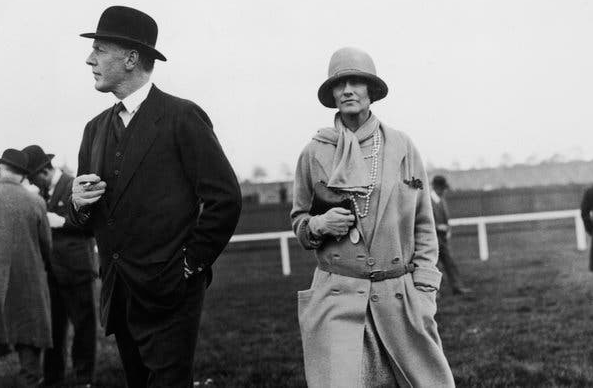
Paris was occupied, couture was collapsing, as for Coco Chanel, the lady who built an empire on freedom made choices that would haunt her legacy long after the war ended.
Coco Chanel built an empire on simplicity, modernity and an almost ruthless clarity of vision. But when the 1940s rolled around the 1940s, the decade that re-shaped Paris, couture, and Chanel herself, after the Second World War, this left behind a chapter that remains one of fashion’s most complicated legacies. It is a story not of espionage glamour, instead it’s a story of Chanel’s that revolves around choices made in the shadows of war. Chanel had refused to re-locate, insisting on her residence to remain in Paris.
Was Chanel a spy or wasn’t she?
The truth is more complicated.
During the German Occupation of Paris, Chanel lived at the Ritz, a hotel that had become a headquarters for high‑ranking German officers. It was there she began a relationship with Hans Günther von Dincklage, a German intelligence operative. Their partnership gave her comfort, protection and access at a time when most Parisians lived under fear and deprivation. It also placed her in proximity to a political world far removed from the elegance of Rue Cambon.
Chanel was not a trained spy, the archives make that clear, but she did collaborate. Her most damaging wartime act was an attempt to use Nazi “Aryanization” laws to seize full control of Chanel No. 5 from the Jewish Wertheimer family. The Wertheimers, anticipating the danger, had already transferred ownership to a Christian businessman before fleeing France. Chanel’s attempt failed but the documents remain.
In 1943, she became involved in Operation Modellhut, a German diplomatic scheme that sought to use her social connections to open channels with Britain. Chanel was not an agent in the professional sense; she was a social intermediary, a woman whose name opened doors. But her participation tied her, however loosely, to German intelligence efforts.
After the Liberation of Paris, Chanel was questioned by the French purge committee. She was eventually released, a decision historians often attribute to her powerful connections, including Winston Churchill. She was never charged, but she was never fully absolved in the court of public opinion.
What makes this chapter so striking is not its drama, but so much as its contrast. Chanel, the woman who revolutionized women’s fashion with freedom and ease, made choices during the war that aligned her with an occupying power. Meanwhile, designers like Lucien Lelong stayed in Paris to protect the couture industry from being dismantled and moved to Berlin or Vienna or both. Their paths once parallel diverged sharply.
Chanel’s wartime actions do not erase her influence nor do they define her entirely. But they are part of her story, which is a reminder that even icons are shaped by the pressures, politics and moral complexities of their time.
In the end, Chanel walked out of the war the same way she walked into it; impeccably dressed, fiercely self‑possessed and carrying secrets she never intended to explain and hoped she could take to her grave. History has spent decades trying to reconcile the woman who liberated women’s bodies with the woman who aligned herself with an occupying power. But perhaps that is the truth of Chanel; brilliance and darkness stitched together, inseparable, impossible to un-tangle. A legend built not on purity but on contradiction.
I’m Stacey Hobbs, thanks for reading. Until next time!
do you feel fabulous today?
 Face by Stace