The decade when Yves Saint Laurent re-wrote the rules of fashion.


“When it comes to pants, Yves is the best.”
— Lauren Bacall
With the smash hit of The Pink Panther,Yves Saint Laurent had already stepped into the world of cinema, designing the costumes that helped define the film’s cool, modern glamour. By 1966, he was no longer Dior’s prodigy no longer the shy guy from Oran, but the designer who would bring fashion into the future. The 1960s were the decade when Yves Saint Laurent became Yves Saint Laurent.
It was a decade of rebellion, sexual liberation and artistic experimentation. Youth culture exploded not for the first time but with a force that re-shaped everything from music to politics to hemlines. Teenagers and young adults became cultural engines, building on earlier waves of fandom that began in the 1940s with the Frank Sinatra phenomenon, when swooning teenage girls became the first modern pop‑culture audience.
By the 1960s, that energy had matured into a global movement. And Yves Saint Laurent didn’t just reflect the decade he shaped it. He understood instinctively that fashion had to evolve with the times and he became the designer who translated the era’s spirit into clothes that are bold, liberated, graphic, classic and timeless, and with modernity.
This is the story of how he transformed the way women dressed, moved and saw themselves.
1. The Rise of Ready‑to‑Wear:
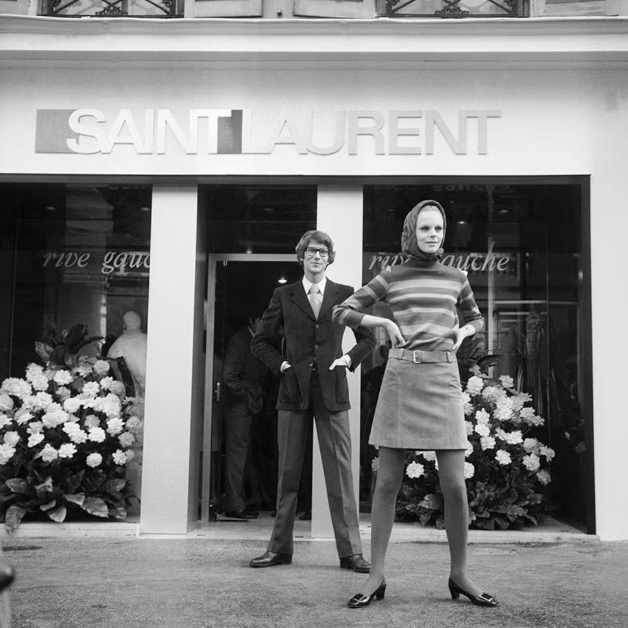
Rive Gauche

In the 1940s, Lucien Lelong laid the groundwork for luxury ready‑to‑wear.Two decades later, Yves Saint Laurent didn’t just continue that legacy he popularized it. In 1966, he opened Rive Gauche, the first luxury ready‑to‑wear boutique ever created by a couture designer. It was a radical shift, talk about elevation when Saint Laurent transformed fashion that had once been reserved for the elite was suddenly accessible, democratic, modern and alive on the streets of Paris.
It was revolutionary.
Saint Laurent believed fashion should not be confined to only salons and society women as it traditionally was. Rive Gauche brought high style to the streets, to students, to working women, to anyone who wanted to experience fashion, style.
It was the beginning of contemporary fashion as we know it today.
2. Le Smoking:
The Tuxedo for Women


For the first time, a woman could walk into a designer boutique without an appointment, without a fortune, without a title. She could try on clothes, buy something modern and beautifully made and walk out transformed. It was fashion as freedom.
Rive Gauche marked the true beginning of contemporary fashion as we know it today, which is accessible, youthful and alive.
And then came Le Smoking.
Le Smoking was the tuxedo for women. Le Smoking brought a scandal and provocation. It challenged every rule of femininity. It blurred the lines between masculine and feminine. It was elegance sharpened into rebellion.
By this point, Saint Laurent was no stranger to controversy. He had learned from Christian Dior himself how to disrupt, how to reinvent, how to sense the cultural shift before it arrived. But with Le Smoking, he didn’t just follow the decade’s spirit — he defined it.
Le Smoking gave women power, sensuality, authority and androgny.
It was the first time a woman could wear trousers in a formal setting and be considered more elegant.
Le Smoking was more than clothing: it was liberation.
3. The Safari Jacket and The Sheer Blouse


Yves Saint Laurent’s genius was his ability to take the un-expected and transform it into something iconic, classic, and timeless.
The safari jacket (1968) turned utilitarian menswear into high fashion with structured, sensual and delivered modernity.
The sheer blouse (1966) introduced sensuality without vulgarity. It celebrated the female body with a kind of elegance that felt both daring and refined, a simple form of revolution in transparency.
These pieces became signatures of the decade, copied endlessly, still relevant today.
4. Art, Culture and Revolution
Yves Saint Laurent absorbed the world around him. From Pop Art, beat culture, African and Moroccan influences, ballet and theatre, cinema, and the youth movements that were re-shaping society of this decade. Everything he saw, read, heard, and felt became material. He translated cultural shifts into silhouettes, colours and attitudes.
He wasn’t designing clothes.
He was designing the spirit of the era.
Ultimately speaking.
Saint Laurent was designing classics.
He was designing timeless.
5. The Woman He Created
The YSL woman of the 1960s was independent, intellectual, sensual, worldly, modern.
She didn’t wait for permission.
She didn’t dress for men.
She dressed for herself.
And the world followed suit.
She was the woman Yves Saint Laurent saw before the world was ready for her and then he dressed her into existence. His designs didn’t just clothe her; they would articulate her. They gave shape to her confidence, her freedom, her intellect, her rebellion. She was the embodiment of a decade that refused to be quiet and Saint Laurent gave her the wardrobe she deserved.
I’m Stacey Hobbs, thanks for reading Face by Stace! Until next time.
do you feel fabulous today?
 Face by Stace