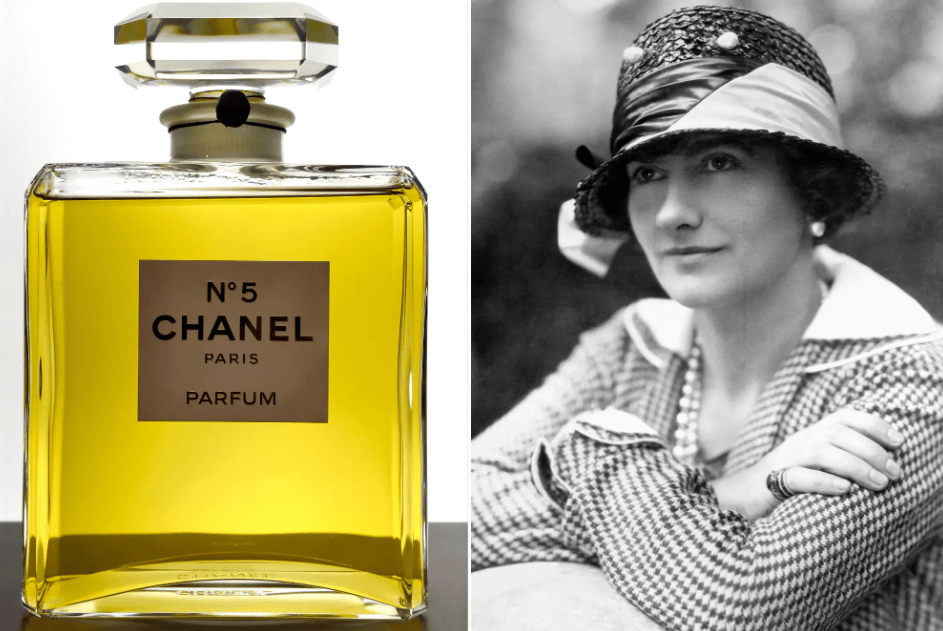
Ah, the ever so classic pardon, Chanel No. 5. The fragrance Marilyn Monroe famously stated, she wears every night going to bed.
When Chanel No. 5 debuted in 1921, this fragrance make an entrance, it rewrote how fragrances were to be made. At a time when women’s perfumes fell into two narrow categories which were single‑flower “respectable” scents or heavy, musky fragrances associated with the demi‑monde, Coco Chanel wanted something radically different. She wanted a perfume that captured the new woman she was dressing.
She turned to perfumer Ernest Beaux, whose innovative techniques and Russian‑French background made him unlike anyone working in Paris. In 1920, he presented her with a series of numbered vials. Chanel chose the fifth vial, a decision shaped by instinct, artistry and her lifelong superstition around the number five.
The result was a scent that felt like nothing else in the world. Brand-new to the world.
A Fragrance Ahead of Its Time
Beaux’s formula broke every rule. Instead of a single flower, he created a complex, abstract composition built on aldehydes — synthetic molecules that added a clean, airy, almost celestial brightness. Their un-usually high concentration gave No. 5 its un-mistakable lift, a quality that set it apart from the naturalistic florals of the era.
Legend has it that the aldehydes were overdosed by accident a “lucky mistake” that became the backbone of the world’s most famous perfume.
Chanel wanted a scent that wasn’t going to fall into any category but her own category. She wanted to develop a scent that was unique and modern.
A Name That Broke the Rules
At a time when perfumes were called things like Nuit d’Amour or Jardin de Rêves, Chanel chose a number — stark, minimal, and shockingly modern. It was a radical act of branding that didn’t require poetry, romance, metaphor. Just No. 5.— Chanel’s lucky number.
The simplicity was the point. It felt clean. It felt new. It felt un-mistakably Chanel.
A Bottle as Modern as the Scent
Chanel rejected the ornate crystal flacons popularized by Lalique and Baccarat. She wanted something “pure transparency… an invisible bottle.” The final design, which is inspired by the beveled lines of possibly a whiskey decanter, became as iconic as the fragrance itself.
Minimalism became luxury.
The Launch of a New Era
When No. 5 was introduced, some had thought or assumed it was just a perfume, however it was the beginning of a new chapter in perfumery. It symbolized the liberated spirit of the 1920s, the rise of the modern woman and Chanel’s belief that elegance could be distilled into something abstract, clean and un-forgettable.
By 1937, Chanel herself became the face of the fragrance in Harper’s Bazaar, cementing No. 5 as both a personal signature and a cultural icon.
A Century of Influence
Over the decades, Chanel No. 5 has remained a benchmark of luxury branding. Its marketing evolution, decade by decade, reflects shifting cultural ideals while preserving the fragrance’s core identity, which so happens to be timeless femininity, modern elegance and emotional resonance.
Few creations in beauty have endured with such power.
Why Chanel No. 5 Still Matters
Chanel No. 5 is more than a perfume. It is:
- a symbol of modern womanhood
- a triumph of innovation
- a revolution in scent composition
- a masterpiece of branding and design
- a cultural artifact that has shaped a century of beauty
It remains the rare creation that feels both historic and eternally new — a fragrance that didn’t just define an era but continues to define what elegance means.
I’m Stacey Hobbs, thanks for reading. Until next time!
do you feel fabulous today?
 Face by Stace