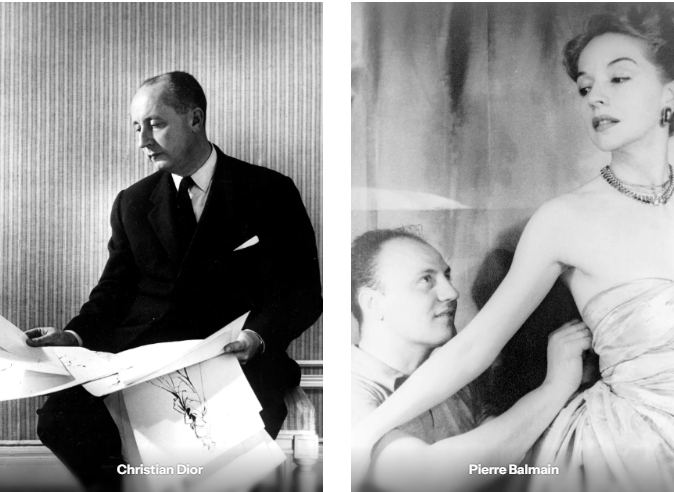
Title: The Architecture of Winter
Setting: The atelier of Lucien Lelong, 15 Avenue Matignon, Paris. January 1943.
Characters:
- Christian Dior (age 38): Soft-spoken, contemplative, wearing a heavy tweed overcoat and a wool scarf wrapped twice around his neck.
- Pierre Balmain (age 28): Sharp, energetic, wearing a patched wool blazer over two sweaters. His wool gloves have the fingertips clumsily cut off so he can grip his charcoal stick.

The Scene: The room is freezing. Breath plumes into white mist with every word spoken. A single candle and a weak electric bulb illuminate two wooden desks pushed flat against each other. Outside, Paris is buried in snow and occupied by German forces.
[Pierre aggressively snaps a piece of charcoal against his sketchpad. He rubs his hands together, blowing on his knuckles.]
PIERRE
If I lose another toe to this frost, Christian, I expect Lelong to pay for the wooden replacement. Look at this. The German inspectors slashed our wool allowance by another ten percent this morning. Ten percent!
CHRISTIAN
[Without looking up, meticulously blending a pencil line with a scrap of fabric]
Screaming at the charcoal will not make the radiator work, Pierre. Work within the perimeter. How much fabric do we have left for the afternoon suit?
PIERRE
Two and a half metres of heavy rayon-blend. It feels like cardboard. It behaves like cardboard. [He spins his sketchpad around to face Christian] So, I’ve given it structure. A severe, boxy shoulder line. Sharp, military-grade darts. If the fabric has no fluidity, we must force it into submission with geometry. It’s commanding. Modern.
CHRISTIAN
[Adjusts his glasses, studying Pierre’s sketch with a soft frown]
It is technically brilliant, Pierre. But it is brutal. It looks like a uniform for a prison guard.
PIERRE
[Defensive]
It is a civilian suit designed under a fascist occupation! Women are walking past soldiers every day on the Metro. They do not want to look like fragile porcelain dolls, Christian. They need a shell. An architecture.
CHRISTIAN
[Sighs, dipping his fingers into a small bowl of cold water to damp his blending stomp]
They need an escape, Pierre. They are starving. They are tired of grey wool and square shoulders. Look at what I am trying to do here… [He slides his own sketchpad across the table]
PIERRE
[Leans in, squinting by the candlelight. He bursts into a sharp, disbelieving laugh]
Christian… this is madness. Where on earth are you getting the yardage for a curved basque? Look at these pleats! Lelong will lose his mind. The inspectors will shut the salon down by Tuesday.
CHRISTIAN
[Gently, but with absolute conviction]
It is all an illusion. I am not adding fabric, Pierre. I am hiding it. Look closely at the interior construction. We slice the waist down to a hand-span—use the scraps from the hem to sew internal buckram pads right onto the hip line. If we squeeze the waist and pad the hips, the skimpy skirt looks like an exploding flower petal by comparison.
PIERRE
[He studies the diagram, his eyes widening as he realizes the spatial engineering involved]
You are manipulating the silhouette to cheat the measurements. You’re using padding to simulate volume.
CHRISTIAN
Exactly. We cannot give them actual luxury so we must give them the theatre of luxury. We must make them remember what a woman’s body looks like when it isn’t carrying the weight of a war. Soft shoulders. Curved hips. A celebration.
PIERRE
[Quietly, picking up his charcoal again]
It’s beautiful, Christian. Truly. But it belongs to a world that doesn’t exist right now. It belongs to the Belle Époque. It’s nostalgic.
CHRISTIAN
[Looking out the frost-covered window into the dark Paris street]
Then I will wait for the world to catch up to it. But until then, I am going to draw it.
PIERRE
[A small smile forms as he begins sketching a new jacket, softening his severe lines just a fraction]
Well… if your flower-women are going to survive the winter, they will still need my tailoring to keep the cold out. Pass the candle closer, will you? My fingers are going completely numb.
This dialogue is fictional, but every detail — the cold atelier, the rationed fabrics, the contrasting temperaments of Dior and Balmain, and Dior’s early experiments with padded hips and sculpted waists — is grounded in documented historical reality.
No dialogue between Dior and Balmain from 1943 survives.
This is 100% true.
I’m Stacey Hobbs, thanks for reading Face by Stace! Until next time.
do you feel fabulous today?
 Face by Stace