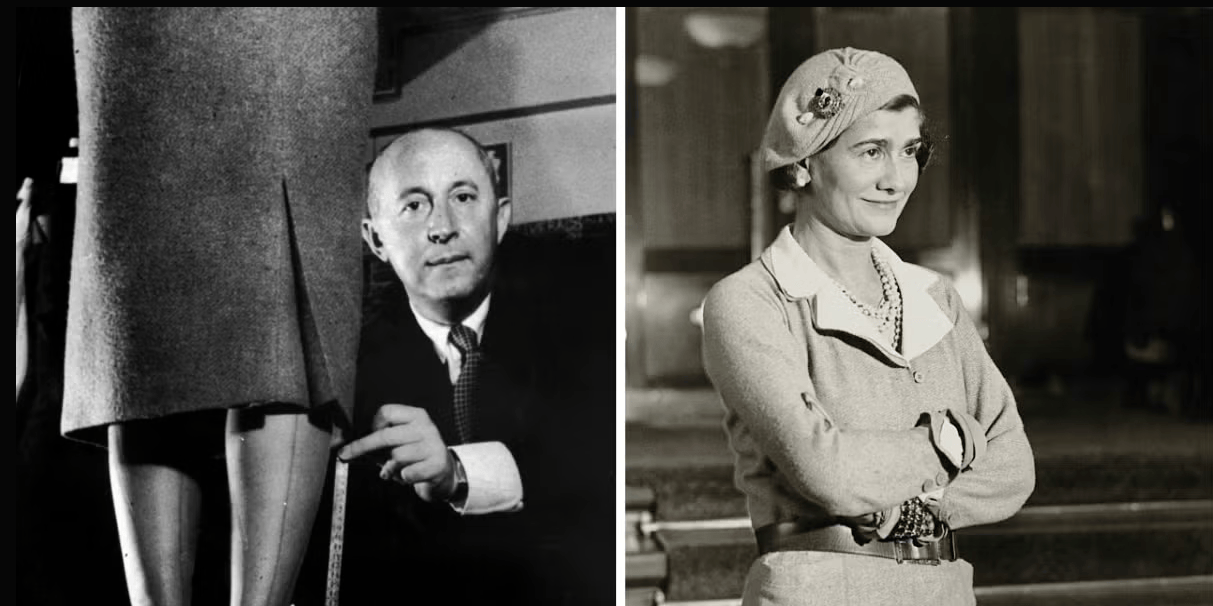
A battle of silhouettes, politics, ego and the future of femininity.
The feud between Coco Chanel and Christian Dior was just as personal as it was philosophical. It was a war between two visions of womanhood, two opposing aesthetics and two designers whose reputations were shaped by re-construction of the mid‑20th century.
When Chanel returned from retirement in 1954, she re‑entered a world Dior had already transformed. His 1947 “New Look” — tiny waists, padded hips, and sweeping skirts — revived hyper‑femininity after wartime austerity. The world adored it. Chanel despised it.
To her, Dior’s silhouette wasn’t revolutionary. It was regressive.
And she made sure everyone knew it.
The Clash of Philosophies:
Utility vs. Radical Extravagance


The Dior Disruption (1947)
On 12 February 1947, Dior debuted the “New Look,” a silhouette that shocked the world. The New Look was not anything that had been seen before. The New Look was:
- sloping shoulders.
- padded bust.
- a hand‑span waist.
- yards of heavy fabric.
- mid‑calf, sculptural skirts, A-Line skirts.
After years of rationing, Dior’s extravagance felt like rebirth. The press hailed him as the savior of Paris couture.
Chanel, watching from Switzerland, saw something else entirely.
The Chanel Backlash
Chanel was appalled. To her, Dior’s designs were not clothing — they were cages.
She famously snapped:
“Dior doesn’t dress women. He upholsters them.”
She compared his gowns to “old armchairs” mocking the layers of tulle, buckram, boning and padding required to create the New Look.
Her critiques were not subtle. They were surgical.
Her core arguments:
- Male designers didn’t understand women’s bodies.
“Only a man who was never intimate with a woman could design something that un-comfortable.” - The New Look erased wartime progress.
Women had run factories, driven ambulances and worked farms. Why force them back into corsets? - The silhouette was a social regression.
Chanel saw Dior’s work as un-doing decades of liberation.
This wasn’t just aesthetic disagreement. It was a cultural indictment.
How the feud started (core facts)
The feud between Chanel and Dior began when Chanel had detested Dior’s New Look collection which was Dior’s first collection upon opening his fashion house, House of Dior. This first collection and his fashion house was produced after serving as Lucien Lelong’s apprentice along with Pierre Balmain.
Chanel favoured comfort, simplicity and menswear borrowing; Dior celebrated femininity through structure and volume. This was a fundamental design disagreement eventually became personal.
Dior’s rise after the war coincided with a cultural appetite for luxury; Chanel’s 1954 return framed her as defending a different idea of modern womanhood.
Chanel publicly mocked Dior’s work and questioned his understanding of women with remarks that were widely reported and intensified the rivalry.
The Feud That Re-shaped Fashion:
Why Coco Chanel Hated Christian Dior’s “New Look”

On 12 February 1947, Christian Dior did something that made Coco Chanel’s blood boil. He debuted his first collection introducing the “New Look,” a hyper-feminine silhouette featuring sloping shoulders, a padded bust, a hand-span waist and an explosion of heavy mid-calf fabric.
To the fashion press, Dior was a savior who restored glamour to a bleak, post-war world. But to 64-year-old Coco Chanel, watching from self-imposed retirement in Switzerland, Dior wasn’t a savior. He was a tyrant dragging women back into the dark ages.
“He Upholsters Them”:
Chanel’s Verbal Warfare
Chanel was never one to hold her tongue and she launched a relentless press campaign against Dior and his male contemporaries. She famously argued that male couturiers did not understand the physical realities of being a woman.
Her critiques were sharp, witty and deeply cutting.
The Furniture Dig.
Irritated by the heavy layers of tulle, buckram and boning required to construct Dior’s dresses, Chanel snapped to reporters, “Dior doesn’t dress women, he upholsters them.” She added that a woman sitting down in a New Look gown resembled “an old armchair.”
The Intimacy Zinger.
Chanel firmly believed that garment design should prioritize physical movement and ease, noting, “Only a man who never was intimate with a woman could design something that un-comfortable.”
The Regression Argument.
To Chanel, forcing a generation of women who had just run factories, driven ambulances and worked farms during WWII back into waist-cinching girdles was a major social regression.
The 1954 Comeback:
A Rebellion in Tweed


In 1954, at the age of 71, Chanel officially came out of retirement. Her singular, driving motivation was to take down Dior. Her weapon? The Chanel Tweed Suit. Well there you have it. The reason that drove Chanel out of retirement.
It was everything Dior was not.
- collarless, boxy jacket
- straight, easy skirt
- no corset
- no padding
- real pockets
- silk linings
- a weighted chain for perfect drape
Introduced on 5 February 1954, her comeback collection was the ultimate anti-Dior. She had a mission what can anyone say. When Chanel returned to fashion in 1954, so did Schiaparelli. Chanel gained success in her comeback whereas Schiaparelli did not find success. Chanel ran Schiaparelli out of fashion leaving Schiaparelli to close her fashion house yet again. So, Chanel believed what she did with and to Schiaparelli, she can do to Dior. She upstaged Schiaparelli in her feud with this artist, even creating a classic the Little Black Dress. This lead to Chanel to believe she could upstage Dior, and with hopes and possibility run Dior out of the fashion industry. Little did Chanel know, Dior was an apprentice of her once friend, Lucien Lelong, with whom Chanel had a falling out with (of course she did), Cristóbal Balenciaga was another friend she had alienated due to Chanel’s sharp tongue, which was legendary. She feuded with Schiaparelli, Balenciaga, Lelong, and nearly every male couturier of her era. But her hostility toward Dior was different. It was ideological.
It was comfort disguised as elegance – a direct attack on Dior’s architecture.
Chanel believed she could do to Dior what she had done to Schiaparelli: outlast her, out‑design her, and push her out of fashion entirely.
But Dior was not Schiaparelli.
He was the protégé of Lucien Lelong, a man Chanel had also feuded with.
He was supported by Balenciaga.
Afterall, Dior represented everything she believed fashion should never return to: corsets, padding, restriction and theatrical femininity.
Chanel represented the opposite: ease, movement, menswear influence and functional luxury.
This time the battlefield was different. Their feud was inevitable.
Two Philosophies, One Industry‑Shaping Feud
Dior
Romantic fantasy.
Hyper‑femininity.
Architectural silhouettes.
Luxury as spectacle.
Chanel
Functional luxury.
Menswear influence.
Physical liberation.
Minimalist comfort.
Their rivalry was personal and yet, it re-shaped the entire direction of post-war fashion.
Why This Feud Still Matters
Chanel vs. Dior wasn’t simply a disagreement between two designers. It was a cultural crossroads:
- Should women return to prewar femininity?
- Or continue the liberation they gained during WWII?
- Should fashion be fantasy?
- Or should it serve the body?
These questions defined the 1950s — and they still echo today.
I’m Stacey Hobbs, thanks for reading. Until next time!
do you feel fabulous today?
 Face by Stace