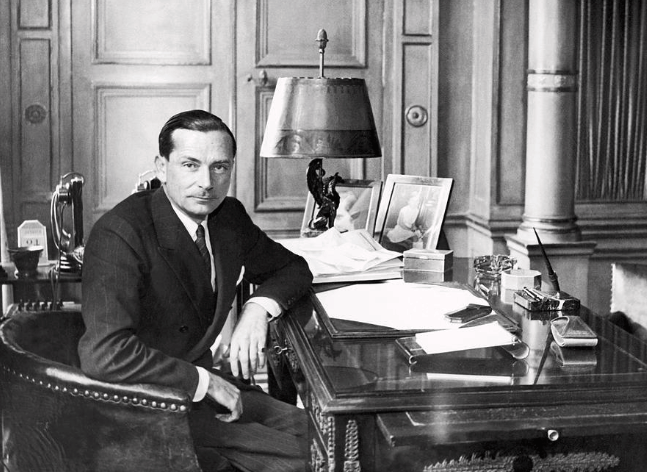

The Early Years and Family Roots
Lucien Lelong was born on 11 October 1889, in Paris, France. He was born directly into the world of fashion. His parents, Arthur Lelong and Éléonore Marie Lambelet, owned a modest but respected Parisian couture house called A. E. Lelong.
With Lelong growing up surrounded by textiles and seamstresses, Lelong developed an eye for style, but he also saw the grueling financial realities of running a fashion business. At the age of eighteen he showed his early flair for marketing by convincing his parents to completely re-model their shop, painting it entirely black to give it a dramatic, jewel-box luxury feel.
An Elite Business Education
Unlike his contemporary designers who trained as apprentices in draping and sketching, Lelong took a highly unusual route for a couturier. He chose not to study art. Instead, Lelong enrolled himself into the elite HEC Paris (École des Hautes Études Commerciales), one of Europe’s most prestigious business schools.
Lelong openly admitted throughout his life that he could not sew, drape fabric or draw a fashion sketch. Instead he viewed himself as an editor, a curator and a corporate director who understood consumer psychology, supply chains and international trade.
World War I and the Scars of Trenches
Lelong’s early career plans were violently interrupted by the outbreak of World War I in 1914. He joined the French Army, serving as an intelligence officer.
In May 1917, he was critically wounded by shrapnel in the trenches. The blast left him with severe abdominal injuries and permanent facial scars. He spent months recovering in a military hospital. Lelong was awarded the Croix de Guerre for his courage under fire.
Building the House of Lelong
Upon his release from the military, Lelong took over his parents’ fashion house in 1920, first order of business was re-naming it Lucien Lelong. He quickly moved the operations to the prestigious Place de la Madeleine in Paris.
Thanks to Lelong’s business-focused leadership, his house exploded in popularity. Lelong refrained from approaching fashion as a typical Parisian, Frenchman, instead his approach to fashion was to adopt the Americanized, corporate mindset. By the late 1920s, he employed over 1,200 people. He was one of the first designers to realize that the traditional haute couture model was too expensive for the modern era, leading him to pioneer the world’s very first luxury ready-to-wear line (Éditions) in 1934 and a highly lucrative global perfume empire (Parfums Lucien Lelong) in 1926.
1926–1930:
Perfume Empire + Industry Leadership Begins
1926: Launch of Parfums Lucien Lelong
Lelong founded his perfume division of his business of his house Lucien Lelong, which became one of the most successful fragrance houses in Paris. He created over forty perfumes between 1925 and 1952, this was the age of Chanel No. 5 (isn’t the fragrance divine?), and early minimalist bottles labeled simply A, B, C, J, and N.
1926: Knight of the Legion of Honour
He was awarded the Chevalier (Knight) of the Légion d’Honneur, recognizing his rising influence in French couture
1928: Committee Member, Chambre Syndicale de la Couture
Lelong was inducted into the governing body of French couture, marking the beginning of his political and organizational influence in the industry, an impact he had imprinted for decades to come.
1930–1939:
Expansion, Innovation & Ready‑to‑Wear Pioneer
Early 1930s: One of the Largest Couture Houses in Paris
By the early 1930s, Lelong’s house employed over 1,200 workers, making it one of the biggest couture operations in Paris.
1933–1934: Invents Luxury Ready‑to‑Wear (Éditions)
Lelong had stepped out of the traditional format of luxury fashion, by pioneering the world’s first luxury ready‑to‑wear line, called Éditions, in 1933–1934. This was revolutionary, couture had never offered accessible, high‑end clothing before. Luxury fashion’s tradition was all about custom-made attire, items if you will, that required fittings appointments, etc. So, for Lelong to skip over the traditionalism by offering ready-to-wear luxury line and in Paris, people didn’t know what to think, how to take this new news, a new genre of fashion attire in how consumers can acquire such items. Lelong was forward-thinking.
1930s — Expands Perfume, Accessories & “Kinetic Silhouette”
Lelong didn’t stop at ready-to-wear luxury line, he introduced modern management practices, large accessory lines, innovative perfume packaging and the “kinetic silhouette,” designed to look beautiful in motion.
His business ran like a corporation, which was unusual for couture at the time.
1939–1940: The War Begins — Lelong Takes Control
As WWII approached, Lelong’s role shifted from designer to industry protector by preventing Haute Couture from being re-located to Berlin by the Nazis.
He was already the head of the Chambre Syndicale, one of the larger employers in couture and a respected diplomat within the industry.
This set the stage for his wartime leadership.
I’m Stacey Hobbs, thanks for reading. Until next time!
do you feel fabulous today?
 Face by Stace