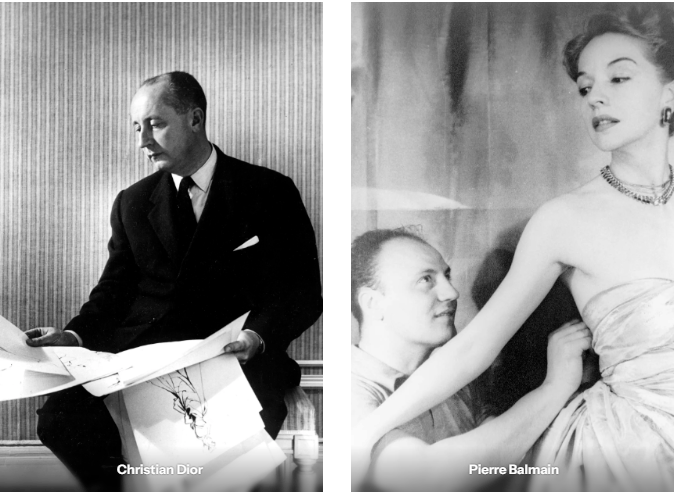
Balmain’s 1945 success signaled that Paris (haute) couture had survived the war. Dior’s 1947 New Look proved that Paris had re-claimed global dominance from the rising American ready‑to‑wear industry.
The French fashion industry re-acted to the debut collections of Pierre Balmain (1945) and Christian Dior (1947) with a mixture of relief, admiration, controversy and cultural tension. Balmain helped re-open the door for Paris couture after the war; Dior blew it wide open and re-defined the global landscape.
Balmain’s “New French Style” (October 1945)
Launching almost immediately after the Liberation of Paris, Balmain’s debut collection was an immediate critical triumph. French and American critics praised his cinched waists, full skirts and opulent draping, describing his aesthetic as a “New French Style” that the re-birth of Parisian elegance after years of occupation.
The New York Herald Tribune ranked the House of Balmain alongside Balenciaga and Molyneux, positioning him as the “golden boy” of post‑war couture. His clientele reflected this glamour with Hollywood actresses, European aristocrats and socialites who craved sensuality, movement and optimism after years of austerity.
Dior’s Explosive “New Look” (February 1947)
Although Balmain had already embraced the ultra‑feminine silhouette, Dior’s debut eighteen months later electrified the world. Carmel Snow of Harper’s Bazaar famously christened it the “New Look,” and the collection instantly re-stored Paris as the undisputed capital of fashion.
Dior’s silhouette — narrow shoulders, tiny waists and enormous skirts — was more extreme, more architectural, and more theatrical than anything seen since before the war. It appealed to aristocratic clients, diplomats’ wives and royalty who wanted formality, structure, and prestige.
Paris vs. America: A Cultural Power Struggle
During the war, American designers had risen in influence. Balmain’s 1945 success had informed the world that Paris couture had survived. Dior’s 1947 New Look proved that Paris had re-claimed global dominance.
American press coverage reflected this tension with some of whom celebrated the return of Parisian glamour while others criticized the silhouette as regressive and impractical.
Economic Impact:
Dior Revives the French Textile Industry
Dior’s lavish use of fabric, sometimes 20 to 30 metres per dress, to be precise, contained more than just aesthetics. It revitalized the struggling French textile industry, which had been devastated by wartime shortages. This economic potential is precisely why textile magnate Marcel Boussac invested so heavily in the House of Dior, which wasn’t an overnight business partnership.
Backlash and Public Protest
Dior’s extravagance clashed with ongoing rationing. Some Parisian women confronted models in the streets, tugging at their skirts in protest of the wastefulness. In the United States, women’s groups condemned the silhouette as excessive and regressive.
These were not full‑scale riots but they were real, documented confrontations that reflected the social tensions of the time.
Peer Critique
The industry split ideologically. Gabrielle “Coco” Chanel famously condemned Dior’s corseted, padded shapes, saying he “upholstered women” and reversed wartime progress. Early feminist writers echoed this sentiment, arguing that the New Look restricted mobility and re-inforced pre‑war gender expectations.
Yet the hunger for post‑war glamour outweighed the criticism. Both Balmain and Dior became commercial powerhouses, each representing a different vision of post‑war femininity.
Press Rivalry and Parallel Success
The fashion press loved comparing them.
- Balmain was seen as the golden boy of 1945.
- Dior was crowned king of 1947.
Though framed as professional rivals, personally the two remained friends, a friendship that began when they had worked together at Lucien Lelong, and admired each other deeply.
Together, They Defined Post‑War Couture
Balmain revived Paris. Dior reinvented it.
Their contrasting debuts shaped the entire direction of 20th‑century fashion.
I’m Stacey Hobbs, thanks for reading. Until next time!
do you feel fabulous today?
 Face by Stace