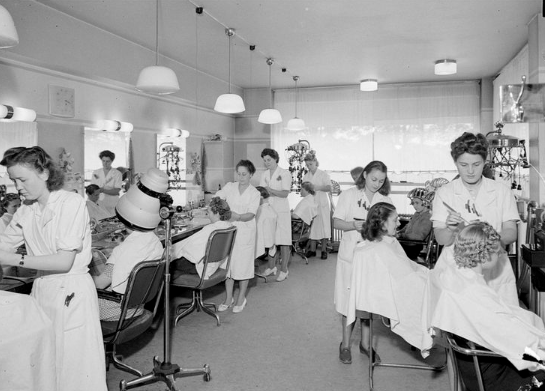
Beauty salon culture in Canada developed along a unique path shaped by immigration, women’s labour and the country’s blend of French, British, and North American influences. By the early 20th century, salons were more than places to style hair, they became community hubs, women’s workplaces, and spaces of social mobility.


Early Roots
Before commercial salons existed, Canadian women relied on home‑based hairdressers, traveling stylists, or male barbershops. Urban centers like Montréal and Toronto saw the earliest shift toward women‑run beauty spaces, often operated out of private homes or small storefronts.
Rise of the Beauty Parlour (1900s–1930s)
As beauty culture modernized, Canadian cities experienced a boom in beauty parlours. These spaces were women-owned, women-staffed, socially acceptable places for women to gather and early sites of female entrepreneurship.
Many early Canadian beauty parlours were influenced by European aesthetics (especially in Québec) and American business models, including the Harper Method.
A Social and Economic Lifeline for Women
By the 1920s and 1930s, beauty salons became one of the few professions where women could own businesses outright.
They offered financial independence, flexible hours, training and skill development and community leadership roles.
For immigrant women and Black Canadian women, salons became especially important. They provided economic stability and created networks of support long before women had full legal or financial rights.
Community Hubs
Canadian salons were also social spaces. Women gathered to exchange news, discuss politics, share advice, build friendships, organize community events.
In many towns, the beauty parlour functioned like a modern-day community centre, run by women, for women.
Influence of the Harper Method
Martha Matilda Harper’s innovations spread into Canada through her franchise network.
Harper-trained salon owners brought professionalized techniques, standardized training, a focus on scalp health and a business model centered on women’s empowerment.
Her influence helped shape the professionalism and prestige of Canadian beauty culture.
I’m Stacey Hobbs, thanks for reading. Until next time!
do you feel fabulous today?
 Face by Stace