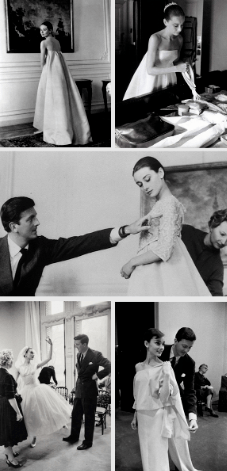
Some partnerships in fashion develop into something meaningful, when a designer meets a woman who becomes more than a client. In this instance, she becomes a muse, a mirror and the embodiment of an aesthetic. For Hubert de Givenchy, that woman was Audrey Hepburn.
Their story begins not with glamour but with a misunderstanding.

A Meeting That Was Never Supposed to Happen
In 1953, Audrey Hepburn arrived at Givenchy’s atelier while preparing for her second film Sabrina. She asked to see “Monsieur Givenchy,” and the young designer assumed she meant Katharine Hepburn, you know the established star. Instead, a slender, wide‑eyed newcomer had walked through Givenchy’s fashion house, wearing cigarette pants, ballet flats and an air of what is now referred to as today, quiet confidence. Otherwise, in the 1950s, it was considered as confidence.
Givenchy didn’t have time for a new client. Whereas, Audrey didn’t have time for hesitation and she wasn’t going to take no for an answer.
She tried on pieces from his current collection, which consisted of crisp white shirts, sculpted gowns, elegant black dresses, and something electric happened. Givenchy’s clothes didn’t just fit her; they transformed her. Hepburn soon became the expression of his aesthetic.
By the end of the fitting, the partnership was sealed.
The Birth of the Hepburn Silhouette
Audrey wore clothes in a different manner than her fellow actresses. She inhabited them. Givenchy understood her instinctively, her ease, her modernity, her refusal to be glamorous in the traditional Hollywood sense.
Together, they created something magical, timeless and classic that still has everyone talking decades later. This new visual language of clean lines, architectural simplicity, narrow trousers,bateau necklines and little black dresses that felt like sculpture.
This was simple and yet elegant, a silhouette that felt fresh, youthful and un-mistakably modern.
Sabrina, Funny Face, and the Making of an Icon
The gowns Audrey wore in Sabrina were the world’s introduction to the Givenchy–Hepburn aesthetic. But it was Funny Face(1957) that made their partnership official. After Givenchy was denied credit for Sabrina, Audrey insisted he be named in the film — a gesture of loyalty that defined their relationship.
Then came Breakfast at Tiffany’s (1961), and with it, the most famous little black dress in cinema history. A dress so simple, so pure, so perfectly cut that it became a symbol of timeless elegance.
A Friendship Beyond Fashion
Their bond extended far beyond fittings and film sets.
- Givenchy created L’Interdit for Audrey, a fragrance meant for her alone.
- She added clauses to her contracts ensuring he designed her wardrobe.
- He remained by her side through her marriages, motherhood and humanitarian work.
- In her final days, he arranged the private jet that brought her home to Switzerland.
It was a friendship built on trust, affection and a shared belief in the beauty of simplicity.
The Givenchy–Hepburn collaboration re-shaped the relationship between designer and muse. It proved that fashion could be:
- character‑defining
- cinematic
- emotionally resonant
- and deeply personal
Their partnership has become, and still influences on modern designers, stylists and filmmakers.
The Givenchy–Hepburn Partnership
1953 — The First Meeting
Audrey visits Givenchy’s atelier for Sabrina. He expects Katharine Hepburn. Instead, he meets the woman who will define his career.
1954 — The Oscar Dress
Audrey wins Best Actress for Roman Holiday wearing a white floral Givenchy gown — one of the most elegant Oscar looks of all time.
1957 — Funny Face
Audrey insists Givenchy receive full credit for the film’s wardrobe, cementing their professional alliance.
1957 — L’Interdit
Givenchy creates a fragrance exclusively for Audrey. It becomes her signature scent — and later, a global bestseller.
1961 — Breakfast at Tiffany’s
The black sheath dress becomes the most iconic LBD in cinema history. Audrey becomes the face of Givenchy’s aesthetic.
1960s–1980s — A Lifelong Collaboration
Givenchy designs her film wardrobes, red‑carpet gowns, and personal clothing. Their friendship deepens into family‑level loyalty.
1993 — The Final Gesture
When Audrey becomes ill, Givenchy arranges the private jet that brings her home to Switzerland. He remains by her side until the end.
I’m Stacey Hobbs, thanks for reading. Until next time!
do you feel fabulous today?
 Face by Stace