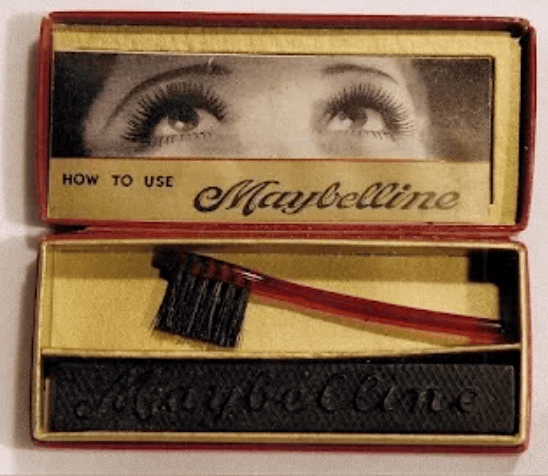
Cake mascara was the standard mascara format. A solid “cake” of pigment that users moistened (often with water or saliva), worked into a paste with a tiny brush, and applied mainly to the upper lashes; it was inexpensive to make (soap + pigment) and carried notable hygiene risks that later helped drive the shift to tube mascaras.


Cake mascara was the undisputed king of eye make-up from the 1920s through the late 1950s, long before the modern squeeze-tube mascara was invented. Because plumbing wasn’t as ubiquitous and women often applied their make-up on the go, saliva became the standard activator, giving the product the notorious street name “spit black.”
What it was
Cake (or block) mascara was a compacted bar of pigment and soap‑like binder sold in tins or small boxes with a mirror and a tiny brush. The formula often used carbon black or similar pigments mixed into sodium‑stearate soap chips.
How common it was
From the 1920s through the 1940s cake mascara was the dominant consumer format; it remained widely used until liquid/cream tube formats began to replace it in the 1950s
Typical 1940s Application Technique
Activate the cake
Users moistened the dry pigment block with a few drops of water or commonly saliva were used to soften the cake into a paste.
Build the paste & tool
A tiny, stiff‑bristled, toothbrush‑style applicator was raked or scrubbed across the cake until a smooth, creamy paste formed.
Upper lashes only
Mascara was swept only on the upper lashes with an upward, curling motion for a natural, defined look. Applying cake mascara on the lower‑lashes was considered theatrical.
Composition and manufacturing
A basic cake mascara recipe: early commercial cakes were essentially a pigmented soap: carbon black pigment blended with soap chips and oils, milled and pressed into cakes. This made them cheap and easy to produce.
Hygiene and Health Risks
The contamination risk of using cake mascara is the repeated usage of saliva, which introduced oral bacteria into the tin and 1940s formulas lacked modern preservatives.
Common consequences of the cake mascara is this practice contributed to styes, conjunctivitis and corneal irritation.
Why this mattered
These hygiene problems, plus the convenience of new applicator designs, helped push the market toward pre‑filled tube mascaras with wands in the 1950s. Helena Rubinstein’s 1957 brush‑in‑tube innovation and later mass products accelerated that shift.
Safer practice today
Activate with clean water (not saliva), use a dedicated, easily sanitized brush, let the cake dry between uses and replace, disinfect or clean by washing tools regularly to reduce bacterial growth. These steps adapt the vintage method while addressing historical risks.
I’m Stacey Hobbs, thanks for reading. Until next time!
do you feel fabulous today?
 Face by Stace