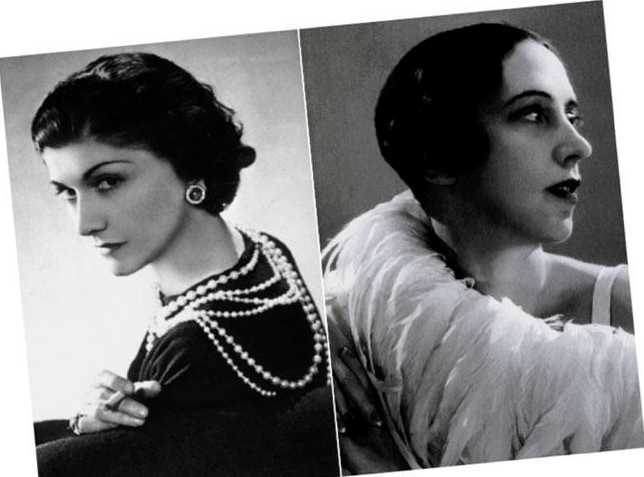
Classic chic or surreal shock? The feud that set fashion on fire.
Well, well, well, a few fashion feuds have gone down in history, but none quite as deliciously petty as this one. In the words of Bette Davis, fasten your seatbelts —it’s gonna be a bumpy ride. Or is it?
Gabrielle “Coco” Chanel and Elsa Schiaparelli weren’t just rivals — they were opposing philosophies in couture. One built an empire on quiet, wearable elegance; while the other turned clothing into theatrical art. Their 1930s feud mixed petty insults, headline‑grabbing stunts and design, where they would one‑up each other, or at the very least attempted to, that left a permanent mark on fashion. From the little black dress to the neon shock of Shocking Pink.
At its worst, the rivalry turned dangerous. From a costume‑ball confrontation that ended with Schiaparelli’s outfit aflame and gossip that would fuel both women for decades. At its best, the feud pushed both houses to innovate, this would include, hidden closures and refined silhouettes on one side, visible zippers and surrealist motifs on the other.
This is the story of how chic met shock, how spite, if one can refer to it as such, birthed staples and why both designers still matter in today’s world of fashion, why each lady earned the title icon, not only in fashion, but as a whole.
Chanel called Schiaparelli “that Italian artist who makes clothes.”
Schiaparelli mocked Chanel’s simplicity.
They hated each other with style.
Before the post-war battle with Christian Dior, Gabrielle “Coco” Chanel’s most explosive, bitter and deeply personal rivalry was with Elsa Schiaparelli. Throughout the 1930s, Paris fashion split into two fiercely competing camps. These were Chanel’s minimalist, classic elegance versus Schiaparelli’s wild, avant-garde Surrealism. Chanel, threatened by Schiaparelli’s soaring popularity, famously refused to even speak her name, referring to Schiaparelli only as “that Italian artist who makes clothes.”
The Chic vs. The Shock:
The Chanel & Schiaparelli War
The Clash of Philosophies: Function vs. Art
The root of their mutual hatred lay in their diametrically opposed views of what fashion should be.
Chanel (The Couturière) believed fashion was a practical craft rooted in sobriety, clean lines and wearable luxury. Her uniform was the little black dress, flexible jersey, and understated elegance.
Whereas, Schiaparelli (The Artist)viewed fashion as a playground for performance art. Collaborating with Salvador Dalí and Jean Cocteau (once a close friend and collaborator, until the relationship included sharp public insults and periods of cooling off), she introduced a dress painted with a giant lobster, hats shaped like upside-down high heels, and drawer-pockets.
The Tension
Chanel viewed Schiaparelli’s work as cheap, un-wearable gimmicks that insulted the dressmaking profession. Schiaparelli viewed Chanel as a boring, predictable traditionalist who was stuck in the past.
Opposing philosophies behind Coco Chanel and Elsa Schiaparelli:
“Fashion is not art. It is a craft.” – Gabrielle “Coco” Chanel
“Dress designing is not a profession, it is an art.” – Elsa Schiaparelli
Monochrome & Neutrals vs. Shocking Pink palette.
Hidden, integrated pockets vs. Exposed plastic zippers.
Hidden interior luxury vs. Sculptural bug & lip buttons.
The Sabotage:
The Human Chandelier Incident
The rivalry escalated beyond press barbs into literal physical sabotage. The feud peaked at a high-society costume ball in Paris in the mid-1930s
he “Human Chandelier” or candelabra incident is a dramatic anecdote often told about the Chanel–Schiaparelli rivalry. At a 1930s costume ball, Coco Chanel allegedly steered Elsa Schiaparelli into a lit candelabra, setting Schiaparelli’s costume caught on fire while guests doused her with drinks, while Chanel looked on.
This story appears in many modern re-tellings and exhibition copy as colourful evidence of their rivalry, but most accounts trace back to later memoirs, magazine recollections or curatorial summaries rather than a single, verifiable 1930s news report. This story may be found in museum/exhibition texts and books on Schiaparelli/Chanel; authoritative on context but not always primary-evidence based. This does not mean the rivalry within itself is well documented; the fire story is not firmly documented.
Iconic Structural Innovations Born
As a Response
Both designers turned personal rivalry into design moves. Schiaparelli weaponized spectacle (visible zips, Shocking Pink, surreal motifs) while Chanel doubled down on discreet engineering and wearable modernism (jersey, the little black dress, hidden finishes).
Elsa Schiaparelli
Shocking Pink; visible decorative zippers; surrealist motifs (lobster, shoe‑hat); theatrical embroidery.
A deliberate provocation against restrained couture, colour and ornament made a public, theatrical retort to Chanel’s understatement.
Coco Chanel
Jersey as outerwear, the little black dress, menswear tailoring, hidden closures and pared finishes.
A counter‑strategy that refines functionality and understatement so that spectacle looks frivolous next to utility.
Evidence and Interpretation
Schiaparelli’s signature moves.
Shocking Pink, the lobster dress (Dalí collaboration), and the use of zippers, which is well documented in museum essays and fashion histories.
Chanel’s practical revolutions.
Popularizing jersey for outerwear, creating the little black dress and the modern two‑piece suit and favouring hidden, refined finishes, which are well attested and represent timelessness.
Was it strategy?
Many historians argue the rivalry sharpened both women’s choices. Schiaparelli escalated theatricality while Chanel doubled down on restraint. A dynamic that produced distinct, lasting structural innovations rather than mere gossip.
The Legacy:
Who Won the Battle?
When World War II broke out in 1939, both houses closed, but their post-war trajectories split drastically. Chanel made a triumphant, historic comeback in 1954. Schiaparelli, however, struggled to find her footing in the pragmatic post-war economy and closed her couture house for good in 1954, which just so happens to be the exact year Chanel returned.
For decades, Chanel won the war of commercial longevity. However in the modern era, both legacies burn bright. Chanel remains a global powerhouse of classic luxury, while the beautifully revived House of Schiaparelli, under Daniel Roseberry, rules in the modern era with the same surreal, shocking energy that once drove Coco Chanel completely mad.
I’m Stacey Hobbs, thanks for reading. Until next time!
do you feel fabulous today?
 Face by Stace