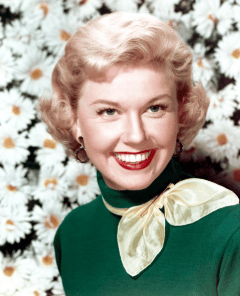
Doris Day’s wholesome glamour didn’t just define her career it shaped the cultural imagination of mid‑century America. At a time when Hollywood was crafting icons to represent national values, Day emerged as the embodiment of optimism, purity, and approachable femininity. Her cornflower‑blue eyes, soft blonde hair and immaculate wardrobe projected a vision of American womanhood that felt safe, cheerful and morally upright.
Her screen persona — intelligent, wholesome, unfailingly optimistic — became the era’s ideal. Critics noted that she “epitomized the ideal American woman of the 1950s,” a figure who balanced charm with understated strength. Even as she played career women, her grooming and demeanor reassured audiences that she remained firmly within traditional expectations. Hollywood used her image to promote stability during a decade marked by Cold War anxieties and shifting gender roles.
Yet Day’s impact extended beyond the screen. Her fashion, hair and beauty routines influenced everyday women, who saw in her a model of polished, attainable glamour. Advertisers capitalized on her appeal, reinforcing her as the wholesome counterpoint to more provocative contemporaries like Marilyn Monroe. Her image became cultural shorthand: the woman men wanted to marry and the woman women felt comfortable emulating.
But beneath the sunshine, Day’s life was far more complex — a contrast that makes her cultural influence even more striking. Her wholesome glamour wasn’t naïve; it was crafted, powerful and deeply embedded in America’s mid‑century identity.
I’m Stacey Hobbs, thanks for reading Face by Stace! Until next time.
do you feel fabulous today?

